
At This Time of Year
Emerging Writer Series

Every two weeks or so I am publishing an essay from an emerging writer. This week, we are publishing “At This Time of Year” by Holly Wielechowski. Holly is a disabled writer from the UK, now based in Michigan. They hold a master’s degree in creative writing, and their work has been published in Bear River Review: An Anthology of Poetry and Prose. When not writing, reading, or editing, they enjoy traveling and spending time with their partner, son, and aging puppy, Murphy. They are currently working on their debut novel.
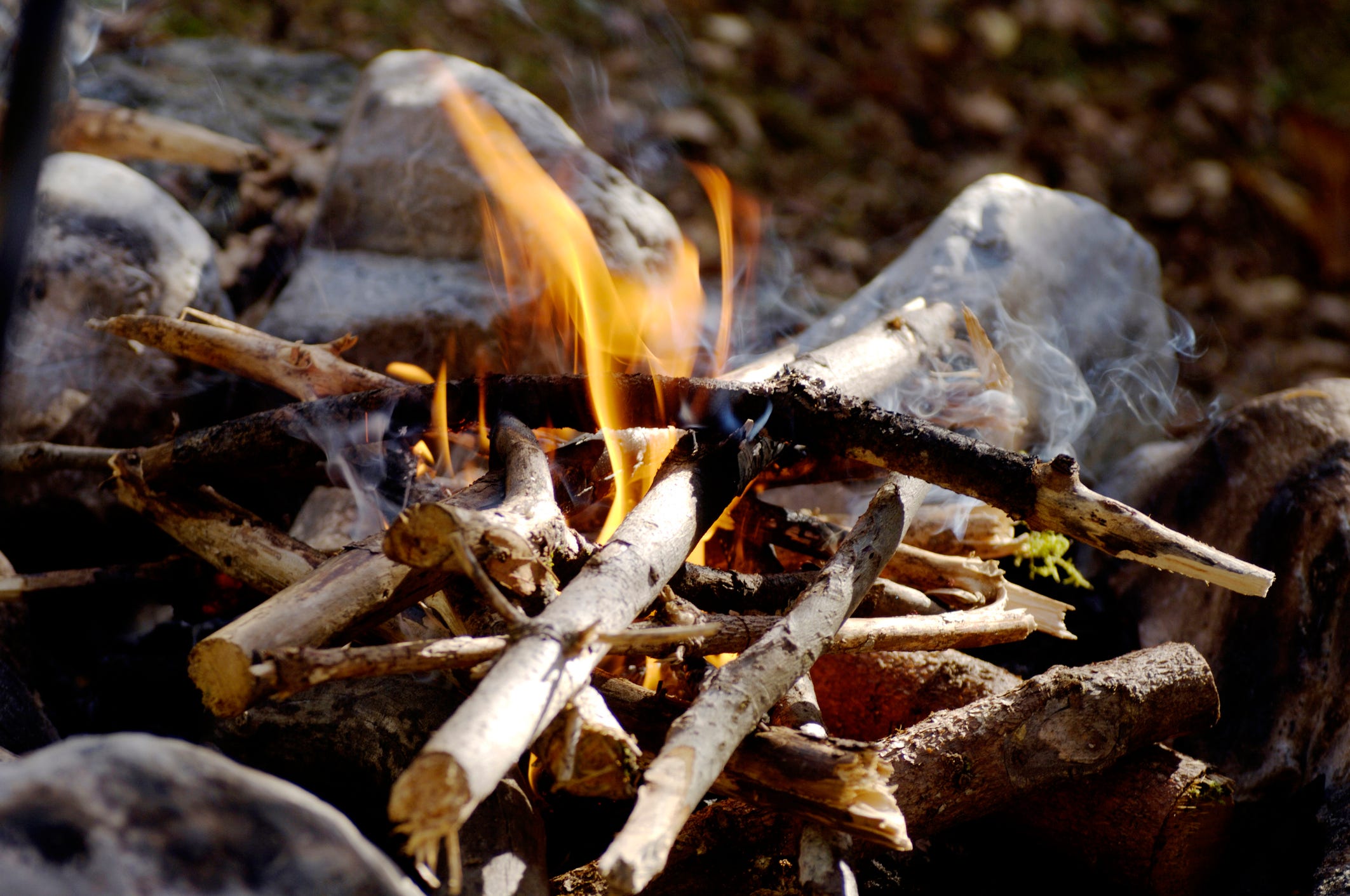
There’s a sense of peace in building a fire, a calm that comes with the familiar rituals of peeling dead paper birch for kindling, gathering twigs to tent the base, and chopping logs into sticks for burning. Each fire brings its own challenges, but my sense of how to attack each one—how to build the fire from the ground up—is a constant that swells my confidence and calms my nerves. I place the fire starter, given to us at the campground check-in, in the fire pit’s center. It is small and pink and squat, a cheat’s candle in its white paper casing. I have no idea what to do with it. Sometimes the things that are given to us to make our life easier, do not.
I gather twigs as usual and place them around the unwanted fire starter. I realize later that it was my own choice to use it, but at the time I feel shafted, bereft of my rituals, which are, after all, the reason I come to camp. I strike the match and hold it against the wick—nothing. Next, I try the paper casing, watching as it burns into itself—not spreading, not warming, just burning down until I fear the flame will disappear entirely. I hastily gather handfuls of dead leaves and place them strategically around the dying flame. Finally, they take.
The rest of the fire is slow to catch up. I must constantly watch and stack and rearrange. Some of the wood is too big for me to chop, so now I am waiting, reliant on my partner for the help I need to really get this thing going. He chops the wood as I feed the fire and eventually, the heat begins to stretch and spread.
I contemplate the number of fires it has taken for me to feel this comfortable in building them. 50 maybe, or a hundred. No one is counting but me as I silently revel in feeling capable and comfortable all at once.
2
Every day there comes a certain point when I must lay back—my head, neck and back supported by elaborate pillow arrangements to ease the pain—and accept that my body is failing me. Sometimes I do this proactively, completing activities in small chunks, limiting myself to just a couple of active hours a day. Sometimes I push my body too hard, thinking I can drive to work, take class, study, and drive home—the very basics of a normal life—without collapse. I do this whenever I feel well enough, but it doesn’t come without risk.
I choose this risk often. I choose it over the restrictive cervical collar that takes as much as it gives, or the clumsy walking stick that hurts as much as it helps. I choose it because it is a choice, and I like having choices. I’m not sure I will always have them.
I’m on the couch when my phone lights up. The phone keeps ringing: another choice. I glance over, but I don’t pick up. I assess the dialing code: physical therapy, calling to schedule more appointments. I need the appointments, but I ignore the call.
Sometimes my life feels like a giant Jenga puzzle. Drive after drive, appointment after appointment, all stacked on top of one another haphazardly, dangerously, waiting to fall. Waiting to topple me.
I am afraid of falling. I’m afraid that if I add one more piece to the puzzle, everything will collapse and I will break open, stitches rupturing, metal casings flying, skin and bones and organs and blood all separating until nothing any longer coheres.
My body was not made to handle this, I think. My body was not made to cohere.
3
At camp, there are fewer pieces to stitch together. I can prioritize my body’s basic needs, and I adore the simplicity.
Each morning, there are tasks to complete. During the first hour, we boil water for coffee, find kindling to light a fire, and prepare a simple breakfast. Our camp site is spacious, but rustic; although we travel and sleep in an old Ford E350 van, we do not have access to the electricity, water, or sewage hook-ups that the more expensive RV sites include. Instead we use the campsite privy, wash dishes in a bucket, and use headlamps when the daylight dwindles.
We bought the van during the pandemic. I was losing my shit, managing disability and depression and then lockdowns too, and after what can only be described as a breakdown on my part, my partner asked to meet at an address out of town. I arrived to find he had $4,000 in cash; we test-drove the van, paid the previous owner, and left in our separate vehicles. I had planned to do the bulk of the renovations myself, but my health quickly deteriorated, and so my partner lovingly, painstakingly worked until it was fit to drive, to sleep in, to camp. The van is basic but perfect. We call it the Rust Bucket.
Before renovations were complete (before it had a bed for us to sleep on and a chair for my son to travel in) we drove my car to upstate New York, camping first in the Adirondack mountains and then in southeast Maine and the Catskills on the way home. It was too busy, too rushed. Three nights in each place was barely enough time to feel the earth beneath our feet.
Each day we drove to a hiking spot or small town, packing in as many sites as we could. In the Adirondacks, we drove 45 minutes to sit on a hill in Lake Placid, unwilling to go inside for fear of catching COVID: our ice creams melted in the blistering heat. We took a short but strenuous hike; we navigated the steep rock face with only a loosely-hung rope for traction, and I prayed that my partner wouldn’t drop our child while descending one-handed.
In Maine, we took a six-hour round trip to Acadia National Park, driving there and back in the same day. When we arrived, I was too tired to summit the park’s main attraction; instead, we drove to the parking lot at the mountain’s peak.
Each night we slept in the tent. The air was cold and unforgiving, and I woke each morning in so much pain that I could barely move. Every day was an exercise in endurance, in proving that my body could do what other bodies could. But my body wasn’t capable. I was exhausted, and something had to change.
4
This summer, our second traveling in the Rust Bucket, we decide to take it slower. We book the same campground—the same tent pitch, even—in the Adirondacks, and enjoy the seclusion of the shaded site, the private path that winds down to the lake, and the rustic privy that allows us to avoid the busy campsite facilities a mile away. We sometimes walk this mile in the morning to stretch our legs and visit the beach, but mainly, we hide away in the woods, enjoying the company of the chipmunks, each other, and ourselves.
This slower pace allows us time to be at camp. The notion of simply existing is one I have fought all my life; whether in the untamed wilderness of rural America, or the run-down mining villages of northern England where I grew up, I have always felt compelled to keep moving. But now, here, my defenses are down; I need to be still. I need to only exist. So we hunt for dead wood, catch bugs with our just-turned-six-year-old, and take sunset swims in the lake. The lake has a current that, if you find the right spot, hits unexpectedly warm and full. Even nature is kinder to me here, it seems.
In the mornings, I wake slowly. Often, I realize my partner has already built the fire; I can smell the sweet, earthy cedar as it smokes and cracks. I stretch and add layers to guard against the chill, and I leave the Rust Bucket with my child sleeping inside, his hair matted, his pale face pressed into the pillow as he dreams.
I love to watch him sleep. I am awed by the translucence of his eyelids—smudges of pink and purple bruising the fragility of his skin, capillaries marking map routes in the cartography of his face. But I don’t want to wake him so I slip out, unnoticed, into the chill morning air.
When I wake this way, I feel I have been given the gift of time. We have no schedule—just basic tasks to accomplish. And though camping pushes me to think about survival, about only the tasks we must complete to make it through the day, it also allows me to renegotiate how my body relates to time, to the day that lies ahead of or behind it. At camp, my body is not pushed or pulled by the currents of the external world. At camp, my body can float.
5
I am treading water. I have an inflatable band strapped around my waist, I am bicycling my legs, and I am in the deep end of the therapy pool. I must try not to tip. It is my one job—to try not to tip.
The therapist chats as I work (I wish she would stop talking). There’s a thing that happens often when you are sick; people want to tell you about their sicknesses, too. People think that you can relate and that therefore you must want to hear about their problems. But I don’t want to hear about their problems. I have enough of my own.
The therapist tells me intimate details about her body, and I unwillingly visualize the things she describes, made easier by the proximity of her unclothed flesh, the wrinkles, folds, and creases all within touching distance, all on uncomfortable display. She tells me the exact nature of the bowel problem she has, how often she uses the bathroom, the duration of her recent hospitalization. I wish that she’d keep her mouth shut—I don’t want to think about other people’s bodies. I don’t want to think about my own body. I don’t want to think about bodies at all.
I did not consent to this, I think. I did not consent.
I keep bicycling my legs, and the therapist keeps talking.
Please stop talking, I think. I am trying not to tip.
6
There is an image I keep returning to. It is a photograph of the fire, the one I made with the unwanted fire starter, taken in night-mode on my phone. The colors are exquisite: blues fade into purples fade into oranges and the night sky, deep and speckled with stars, forms an inverse canvas behind. It looks like art. It feels like magic.
Each time I look at this picture, I am reminded that not only am I capable—not only can I build something needed—but that I can also build something beautiful. I like knowing that that beauty is still out there. I like knowing that something beautiful can come from my own hard work. I like realizing that, despite everything, beauty is still a thing that motivates me.
I look at the photograph whenever I feel like I’m drowning. The image is a surrogate, a proxy for when camp is inaccessible and my body no longer feels like home. It brings to mind the smells, the sounds, the sights—the entire sensory panoply that a real fire affords. I let these sensations wash over me, and I feel something akin to peace.
7
I am drowning. I am submerged in dark water, its weight heavy on my skin. I have been wading through it for days, weeks, months now, my legs dead weights, my chest caving from the pressure. I am swimming through mud; the exertion of it hurts my body, makes my head ache, and fatigues my every sense.
Sometimes I wonder if it’s all in my head. I wonder if my symptoms are the result of an overactive victim complex, of an uncompromising need for attention. I fear I might not be sick at all, but instead incapable of relaxing, incapable of finding joy.
In these moments, my history of illness is illegible. Official records read as smudges and smears, x-rays become the blurred sketch of an undisciplined hand. My medical history feels like the well-worn joke about doctors’ handwriting; it is unreadable, unreasonable, and unreliable.
I do not voice these fears aloud; I can’t risk others doubting me, as some already do. And it’s only wishful thinking (another way I’ve found to drown).
Will I always be drowning? As a child, I was told that drowning meant death. No one warned me that for some, death never comes. Instead, I must drown perpetually, continually, forever. There is no recovery, there is no death. Just drowning. Always drowning.
8
I am waiting to see a new endocrinologist, and the new doctor anxiety has set in. I have shared my complicated medical history countless times before, but still my every nerve is frayed to the root. I wonder whether the doctor today will be competent and compassionate or, as is frequently the case, arrogant and reckless.
I complete the routine. They measure my height and weight, reminding me that I have not yet summoned the courage to refuse these pointless checks. They declare my blood pressure excellent, despite the medications I’m on to raise it to this level, despite the fact that even so, it’s still too low. I do this even though the same healthcare system took these measurements twice last week. I do this because they are the experts, and because they have asked me to. But inside, I am angry. Does no one read the notes? I think. I have been here for 15 minutes and already, I no longer feel like a human being.
I am led into a room; after a long wait, the doctor arrives. He is middle-aged, balding, cheerful. He is loud, talkative, full of himself. He brings in a medical student; these students come in often to learn about “complex cases” like myself.
He asks what brings me in, then cuts me off to explain my list of diagnoses to the student. Some of the items are so basic I’ve known them for years; the student looks frustrated but nods politely, answering when asked repeated questions. When the doctor is not asking questions of the student, he is asking questions of me. Most of them are about my English accent; not many are about my health. My faith wavers, and my patience thins.
I am here to discuss a previously diagnosed endocrine disorder, but as soon as he learns of my “rare” disease his attention shifts. I debate if I should bother correcting him, if I should demand recognition of his error. I want to yell that the specific form of the disease I have is not, in fact, rare—but I am tired of being the teacher. I remain quiet.
“Did you get an official diagnosis?” he prods. “What criteria were you measured against?” I wonder if I’m here to get medical help, or to prove myself to yet another stranger with no skin in the game.
I should know what to expect next, but I don’t see it coming. I comply because I’m caught off guard, and because that’s what I’m supposed to do. I comply because I don’t feel I have a choice. I did not consent to this, I think, and I am no longer calm. Instead I am crying, and the doctor doesn’t know where to look or what to do, and the medical student looks as though she wants the floor to open up and swallow her whole. Meanwhile, I keep crying. It feels like the only choice I have left.
The next day, the doctor’s secretary calls; she wants to check that I’m okay. I tell her I am not, and that the doctor is to blame for that. I tell her I plan to submit an official complaint. I tell her that his behavior is unacceptable and damaging to his patients, to me. There is something in her voice—sorrow maybe, or panic—and I wonder how much of this conversation she will even relay. You can tell him “Fuck you,” I think, but I know I must keep my cool. I hang up the phone, and I cry some more.
I am too exhausted to write the complaint.
9
In the acupuncturist’s chair, I find some sense of the peace I feel at camp. I wonder if this is due to the sheer amount of greenery in the communal space, thick vines that trail everywhere, elaborate systems of strings and pulleys leveraged to dangle foliage from above, an illusion of forest in this deeply urban environment.
The space is designed to be relaxing, but I don’t find it so. I don’t find the sharp sensation of the needles calming. As her hands gravitate toward me, I flinch and clench, waiting for the prick, the tiny scratch that is so miniscule in comparison to the other horrors my body has endured since diagnosis but that still, somehow, breaches my physical and emotional boundaries, my studied sense that I am impervious.
I wonder if this is the same fear I experience with allopathic doctors. I don’t need to perform here; there are no circus tricks required to prove my illness, to qualify for treatment, to be treated with “care.” But still I’m anxious about putting my body in a space where it has no control. The acupuncture room is peaceful, but still I must prepare for the scratch of the needle, the prick that could burst me open. I am waterproof, I think. I am watertight.
But the needle punctures my skin, and I know that I am not.
10
The seasonal adjustment that follows a summer of camping is difficult to bear. The days shorten, the weather cools, and the academic schedule kicks back into gear. My daily routine is no longer focused on survival; instead, the commute from the suburbs to the city shapes my day, and I spend my time in the cold glare of a laptop screen, working on my dissertation, preparing online classes, and grading undergraduate papers. These time constraints mean we can no longer travel far, and soon the nightly temperature drop will force us to abandon camping completely.
I make daily visits to my favorite city park, a floating foxhole in the Detroit River. I view the contours of the city skyline from a distance, and I imagine that I am not part of it but separate, far away. But this is only an illusion and the sadness remains, amplified by my sense of alienation and the dreary determination of the autumn rain.
I realize then that this island, this refuge I now rely on, is nothing more than my cheat’s candle writ large. It is a swindler’s shortcut that leaves me bereft of my rituals, deprived of my due. I am not at camp, and I cannot build the fire.
The sense of sorrow I feel at this time of year is deep and abiding and seems, to me, a natural counter to the calm I find at camp. Those first moments after the fire has been built—when I can confidently neglect it for a few minutes or simply sit and enjoy its warmth—feel rewarding and rare. It doesn’t seem to matter how many fires I build—there is always a sense of having overcome the odds to create something miraculous.
Building a fire is a difficult task—one that doesn’t always work. But the reward outweighs the risk, and I return to these rituals each opportunity I get. For though there are many ways to build a fire, not all bring the same sense of achievement.
 | A guest post by
|
"No one is counting but me" made me catch my breath...
I started reading and realized I needed to wait until I could give this essay my full attention. Beautiful, thank you for sharing.
This piece of writing made me say “Wow!”
Turning the exhaustion and the "smudges" of your medical history into a story as beautiful as that night fire is truly brave. You show what it feels like to be a "complex case" among strangers, but you still see hope in the cedar smoke and your son’s face. Thank you, Holly, for sharing this. It reminds me that even when our bodies don’t feel like home, what we create with our own hands can still be amazing.