
Cutting, Both Ways
Emerging Writer Series


Every two weeks or so I am publishing an essay from an emerging writer. This week, we are publishing “Cutting, Both Ways” by Lacey Jones. Lacey thinks and writes about despair, repair, and secular aesthetics. She has a PhD in English and Religious Studies and works as an associate editor at The Yale Review. Currently she is at work on an essay collection and applying to medical school. You can find her fiction in The Kenyon Review and her poetry at Image.
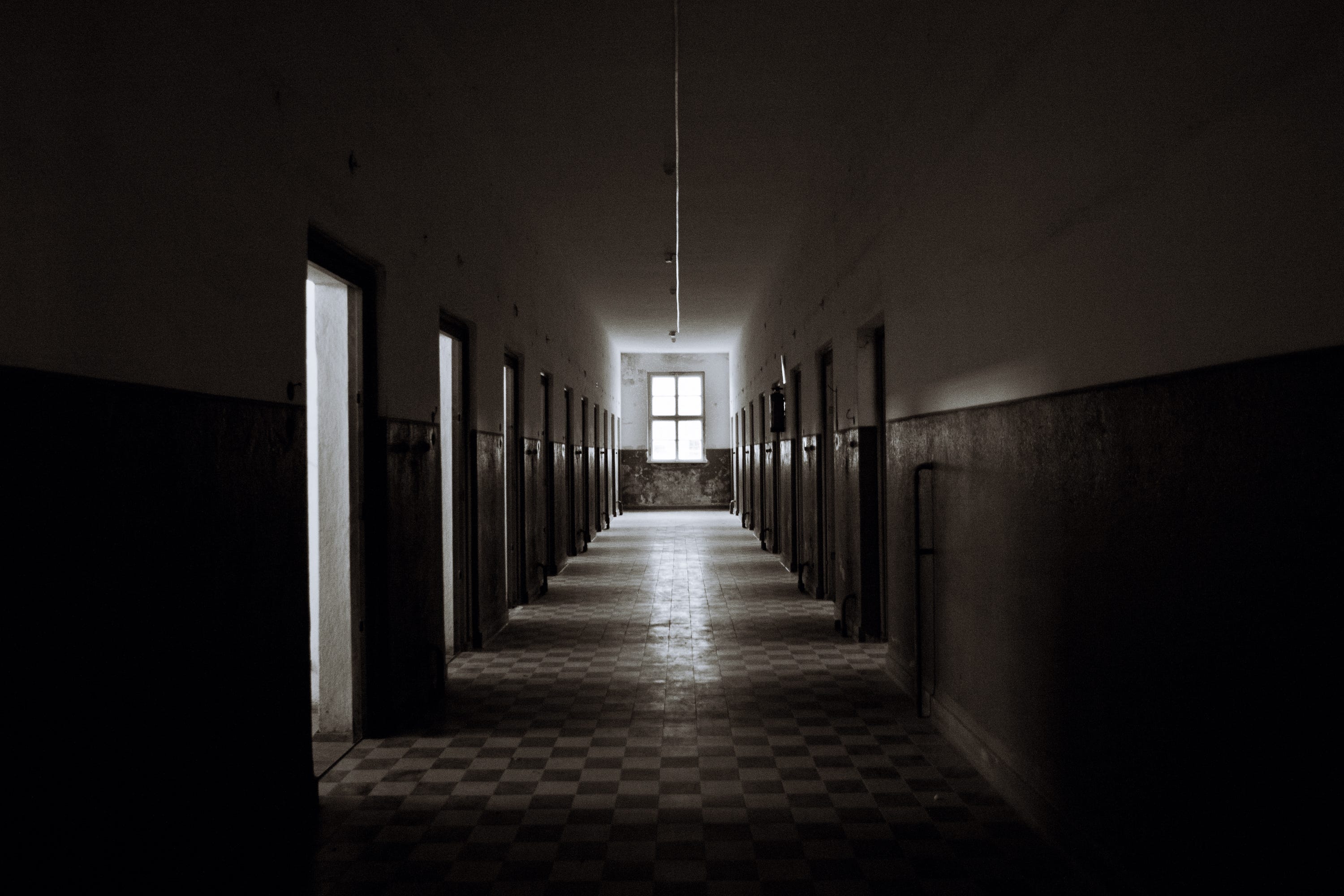
I am a 32-year-old English PhD who plans to become a physician, so I volunteer in the basement of a psychiatric hospital with garishly painted walls: mustard yellow, Jolly Rancher green, mouthwash blue. Every week, security buzzes me through to a hallway lined with abstract paintings. My favorite is flecked with small orange splatters. Thin, black lines slash across the right half like tally marks. I walk past it on Friday mornings with an eye roll at how fucked up it is that someone hung that painting in this hall. Then I head downstairs.
My first time watching the procedure, the doctor wouldn’t shut up about his patient’s arms. She was lying unconscious in front of us, electrodes attached to her temples, and he kept talking. “You see all of that scarring? It doesn’t mean she’s suicidal. She cuts herself,” he said, “because she is depressed.” He looked me over and nodded—“someone like you or me might not understand the urge.”
--
Assuming you don’t slash open an artery or contract an infection, the risk of cutting is a risk of associations. Non-suicidal self-injury (NSSI)—including behaviors like head-banging, skin-picking, and burning—is correlated with psychiatric diagnoses such as depression and anxiety, PTSD, substance use and eating disorders, increased identity confusion, a poor regard for one’s body, and childhood histories of abuse and/or sexual trauma.
As Sarah Chaney’s Psyche on the Skin makes clear, the history of cutting is also full of associations. Self-injury has been deemed symptomatic of everything from suicidality to hysteria, from ‘a cry for help’ to a so-called manipulative strategy of emotional regulation. Cutting became understood increasingly less as a symptom and more as a choice—and the distinction between those categories became as important as it was inscrutable.
In the mid-1900s, for example, self-mutilation signaled the edge of psychosis—American and British clinicians alike puzzled over patients who were ‘ill enough’ to cut themselves but who in other moments acted completely well. Such cases elided existing diagnostic categories and so were often labeled borderline, a term that Robert Knight’s seminal 1953 paper “Borderline States” insisted “convey[ed] no diagnostic illumination of a case other than the implication that the patient is quite sick but not frankly psychotic.” When psychiatrists eventually formalized diagnostic criteria for borderline personality disorder (BPD) in the 1980 DSM-III, self-mutilation was listed as a symptom. Over 45 years later, NSSI is still associated with stereotypes of BPD in the popular imagination—impulsivity, melodrama, and extreme manipulation.
Controversial today for its pathologizing of trauma, BPD was once one of the few places NSSI could be found in the annals of modern American psychiatry. It wasn’t until 2013 that non-suicidal self-injury appeared as a separate listing in the Diagnostic and Statistic Manual of Mental Disorders (DSM), filed in its very back pages amidst the “categories for future study.” Proposed criteria for the would-be disorder managed to span both the intentionally vague—to qualify, self-injury must cause significant “distress” to the patient—and the arbitrarily precise—self-injury must be inflicted at least 5 times, via socially unacceptable means (tattoos, e.g., don’t count), within a single year. DSM-V also listed a self-injurer’s possible motivations: relief from pain, interpersonal conflicts, sometimes “self-punishment.”
---
Most doctors only asked me easy questions: “What do you use?” “Have you ever gotten an infection?” “When do you cut?” “Where?” “Do they bleed?” “How deep do you go?” “Do you have a preferred design?” One of them asked me to hold up my arm in front of my laptop so they could see my cuts over Zoom.
I had my own designs at the beginning: long diagonal lines that overlapped to form a grid of diamonds. I used to let the blood congeal between rounds so that my blade hitched a little at each intersection when I made the cross hatches. But diagonal lines didn’t scar, so I started making em-dashes instead, quilting a 4x4-inch square of my forearm with short, shallow, inflamed lines. I’d let patches of them fade into a salmon color and then start again, covering my skin in various stages of recovery. I like it best when the blood lags behind and a crevice forms, shocked empty for a second before it goes red. Some of them healed like that, tiny, colorless, barely visible indentations amidst more visible scars, white and slightly raised. If I pull on the skin, it looks like I’ve wrapped my forearm with thread, very tightly.
After a while I started doing it with my thumbnail too, in class, in meetings. Like I was scratching an itch. Go through enough layers of skin, and clear, watery liquid starts seeping out. I stop before I get to blood. The line swells up; the skin goes white around the edges. The center hardens into a nauseating brown the texture of fruit leather. People believe me when I tell them I burned myself on my curling wand—I cluster the lines near my right wrist so it just looks like I keep scalding the same place. Clumsy. I’ll rip the scab off a few times, to deepen the crevice, until I can hold my wrist at eye level and see a dip in the horizon line. That’s when it bleeds. But no matter how many times I tear off the scab, the cut heals into a dark pink patch of skin. It slowly begins to fade, and then, months later, it raises itself into a small, pillowy mound. I’m bothered by the subtlety of all this, bothered by the camouflage of my freckles, by brown hairs on pale skin. Healing doesn’t leave enough behind.
I want proof, so I google scarification techniques and rub my cuts with exfoliant, then spend the night sleeping with plastic wrap around my forearm. The next day, I think better of it. It’s more honest to hide my training: long sleeves, the band aids I keep in my gym bag, scrunchies, my Garmin, professional-grade concealer that never quite works, temporary tattoos over the scars before family vacations, lies about cat scratches or onion chopping mishaps. Real love has to be offered, not asked for.
---
There’s a special hashtag for self-harm on X (Twitter)—#shtw—where people sometimes post pictures of their cuts. Tumblr has a seemingly endless list, including #styro, #sh, #slef harm, #beansblr, and #cvutting. For more than a decade now, major news outlets have been decrying the trend. When public distaste waxes, social media companies institute nominal bans; tech moguls promise to end the romanticization of razor blades and blood. But they do not, and it doesn’t matter that they do not, because a simple internet search turns up images more horrifying than the hashtags’. Lest its algorithms be accused of dumping kerosene on the flames of social contagion, Google pastes the number to a suicide hotline above its photo gallery and asks you if you’re doing okay. The world wide web is full of humiliations, including its proposed alternatives: draw on your preferred zone in red marker, rub an ice cube across your forearm, dance around your bedroom. Reddit recommends stabbing an orange. You can find community there too. There’s r/selfharm for people who take themselves seriously, r/adultselfharm if it didn’t get better, and r/madeofstyrofoam for adolescents with a dark sense of humor and a knack for insider lingo. “Are you feeling mango?” they ask each other on posts with shitty memes affixed to them. “What do I do if I hit styro? beans?” “I feel sewerslidal rn.”
In r/afraidtoask, occasionally a poster wonders if self-harm scars are a “turn off.” Some commenters say no (“I used to cut, so I understand”); some say not if the scars are old (“They’ve put that chapter of their life behind them”). But a lot of them answer with yes (“I don’t put my dick in crazy”). Meanwhile, half the planet Earth is tweeting about the dosages of their psych meds and their relationship problems and their capitalist burnout and their narcissistic mothers. I know about the suicide attempts of people I’ve never spoken to. Everyone on the internet wants me to want them to be saved. Reading X (Twitter) confessions feels like wandering around a world of mimes weeping into each other’s shoulders—performative suffering met with performative care. And I am writing this.
--
Welcome to the trauma economy. Value is the measure of how much you deserve care, and your value is determined by your suffering. Worth appreciates when you have no agency in your pain, when you are the one being wounded. The trauma economy hates choices, prefers when agency has been possessed by pain. Most people can garner enough capital to survive if they market themselves. Tell the story of your childhood; tell the origins of your suffering; tell how it’s all engrained so deeply into your psyche that your trauma has become inextricable from your being.
Going bankrupt in this economy isn’t about not having pain. Sometimes it’s a matter of power: cheating politicians, rapists, billionaires, cops. The trauma economy loves a fall from grace. Sometimes it’s a matter of the wrong desire—even celibate pedophiles are reviled. But it’s cutters who the trauma economy really hates. Post your pain on your body, and they’ll siphon your accounts. They’ll clean you out. The only self-infliction worth anything is the kind where they can believe infliction has slipped outside the boundaries of control. Cutters are like millionaires looking for tax breaks, circumventing the rules to inflate their own value. You’d hate me for my calculations. You’d hate me for how many stopgaps there are between me and blood: decide where, how deep, which direction, what tool, how many times. You’d hate me for making so many choices, for using choice to shortcut my pain, but what I wanted was to obliterate my agency: if I hurt myself badly enough, my existence would become someone else’s problem. It never happened. The trauma economy wasn’t buying it. Needing something means you’ll die without it, and I was still alive. My longing meant enough distance from disaster—an endurable deprivation.
I keep trying to get to breakdown, but I can’t do it. I want the kind of care that answers to a need so subsuming it obviates the need for asking. What a terrible thing to hunger for. I discipline my longing by meeting it halfway. I cut enough to desire care but never enough to deserve it. Every time, I wrap my arm in the same blue hand towel afterwards, the one that smells like baby powder, and I lay somewhere—my bed, my couch, the floor—and hold it against my chest, breathing in the scent.
No one can tell me if need is a form of negation or repair. A professor of mine once asked me why I cared so much about breakdown. We were sitting outside at a table in early spring, and I was thinking about decay and fragmentation and dissolution and my dissertation prospectus, and she was drinking orange juice. Both of us were wearing impenetrable sunglasses. A year before, she had texted me a picture of leaves frozen under ice and told me it reminded her of my writing, which, she said, didn’t have a heartbeat. Now she wanted to know if my whole dissertation project had started because I was jealous of people who had breakdowns, because I wanted to have one too. Like when you’re a kid, she said, and your friend has their tonsils removed and gets to eat ice cream, but you’re healthy so you can’t have any. I told her I believed desire was only worthy of being met when it became need, and breakdown was the moment of alchemy. I told her I kept trying to get there but couldn’t.
“That’s some deep, dark ascetic shit,” she said. “You should write that down.”
--
Cutting and writing are a lot alike, the same dance between exposure and concealment, the same promise of being read without having to answer to your reader. This essay might be an exercise in redundance. Writing, Maggie Nelson says, is “a mordant—a means of binding color to its object—or of feeding into it, like a tattoo needle drumming ink into skin.” Writing makes explicit some implicit sensation, dissipates my feelings somewhere in the interplay between concretion and sublimation. I can inscribe my pain and maybe learn to trust it. Still, Nelson continues, “‘mordant,’ too, has a double edge…it is not just a fixative or preserver, but also an acid, a corrosive.” Drum color into skin, and you have to wipe away the blood. YouTube offers a steady stream of videos that star girls in their early twenties sitting in tattoo parlors and reflecting on their teenage melancholy before covering their forearm with a predictable tangle of flowers. I fantasize about getting one too, but I keep putting it off. Google doesn’t have much to say about what happens if you start cutting again, over your tattoo this time.
--
Psychologists like Margaret Woodruff believe cutting is a form of semiotic violence: “in self-mutilation, the thing, the cut, takes the place of a word, or symbol…what is being communicated is a violent rejection of speech.” But I don’t think cutting rejects speech. Instead, maybe cuts are attempts to expand what it’s possible to think—attempts to communicate the precise moment where desire becomes need, attempts to see a tipping point that lies past the border of language.
I had the feeling that my self was an idea I could never get to. The cuts were bloody and boring, but they literalized the lack.
Philosopher Maurice Merleau-Ponty has a different theory about acts of existential refusal. It’s not just, he says, that anorexia is a “refusal of living” or that aphonia is “a refusal of speaking”—it’s that these are modes of refusal “torn out of the transitive essence of ‘inner phenomena’” and made into “factual situations.” He says it’s in this way that the body is an agent of conversion, capable of “transform[ing] ideas into things.” But what if cutting is the refusal of conversion, a thing that happens when I can’t figure out how to be changed? What if it is what my body does with intransitive inner phenomena, with dead-end emotions of shame, with feelings that can’t become something else? “If the body can symbolize existence,” Merleau-Ponty continues, “this is because it actualizes it and because it is its actuality.” Suicide is the limit case of symbolic transformations. Resurrection is their guarantee. I tried cutting as a kind of compromise, a prologue of self-effacement.
Cuts feel like self-loathing feels, mealy and stinging. They extend the hell of that feeling as they heal: a dry crepeyness tethered to live flesh, an itch that pulls towards a deeper soreness at the seams. For a while I used to go to this one spot in the park, on the river, tucked back off the path and shielded by bushes and the roar of a waterfall nearby. The view from the opposite bank is unobscured, and I used to look straight at the people across the water as I sliced my arm open. Sometimes there were parents there with their children, and I’d think about how horrified they’d be, how they wouldn’t let their kids anywhere near me if they could make out what I was doing. But they couldn’t, and I’d sit there and cut in broad daylight like a giant fuck-you to the world outside my hell.
--
Recent scientific literature on NSSI identifies thought patterns associated with acts of self-injury: hopelessness, rumination, self-aversion, maladaptive perfectionism, unstable identity. In study after study, NSSI emerges as a failed feedback loop: a person has an unstable identity, they self-harm to find identity as a cutter, identifying as a cutter impedes the formation of a stable identity; cuts disclose pain in the hopes it will be received, this method for exposing despair leads to its dismissal; media representations aim to destigmatize NSSI, such normalization is accused of heightening social contagion.
To communicate in the language of cuts means alienation. I try to find intimacy, but I keep turning things into myself: the Midas touch of an unhappy solipsist. My kingdom expands, but in the end all it means is that I can’t escape my own control. I keep trying to draw a border around everything. The impulse might be sympathetic: self-defense against profound fear or past pain. It’s also a violent one. I try to possess everything, but the problem is that once you take everything into your borders, nothing survives. I can’t stand up under that kind of weight, but by the time the inevitability of collapse becomes clear, I’ve made all of it necessary, turned it all into part of my survival. It’s impossible for anything to escape the bloody horizon line. Self slices open self and arrives at the same. I can’t get out.
Audre Lorde calls “the ascetic position…one of the highest fear, the gravest immobility.” My professor, the one with the orange juice, says I am an ascetic and that ascetics are scared of need. She says they are people who rush to escape their need by converting it to something else. That something else may be, as Lorde writes, “severe abstinence” and “self-abnegation,” but it might also be cutting, which is often accused of being a self-indulgent, manufactured surfeit of pain, an inability to withstand wanting. Maybe the most fucked up thing in the world is to escape your need by desiring it instead. Cutting is my attempt to survive starvation, but it comes with a blind spot: the acceleration of desire into need at the expense of making those words intransitive.
I had the feeling my self was an idea I could never get to. What I wanted was revelation, but I started to suspect there was nothing behind the curtain. I started to suspect I was the curtain. I had conflated the movements of hiddenness and disclosure. Cuts do this too: show people something while forbidding them to know what, in fact, is there. Like a safety release valve for pain—the relief of passing a flash of your despair on to someone else enables the continued restraint of keeping a lid on your need. I disguise myself as a curtain, so that people look long enough to wonder what’s behind it before deciding it’s something they don’t want to see. In a way, they’re right: if they pulled me aside, there wouldn’t be anything there. My friend, a book critic, is less generous—“in recent years,” she writes in the margin of my short story, self-harm “has been many authors’ (Rooney and Lacey are two that come to mind) go-to mechanism for affording their female characters depth.” She isn’t a fan.
--
The protagonist in HBO’s Sharp Objects is a reporter and a cutter with words carved all over her body—wrong, wicked, fallen, laid, drain, cherry, sick, gone. To convey the horrifying specificities of her pain, she carves its literal language into her skin. But Camille’s body winds up speaking mostly of its longing to be read. Everyone is horrified by such an open secret. The show’s characters have a lot of opinions about Camille’s scars—her mother says she’s ruined herself; the cop from out-of-town mistakes his pity for love; her younger sister is enthralled; the teenage murder suspect empathetic.
Sharp Objects features children’s corpses with their teeth torn out, gang rape, suicide, child abuse, and a sex scene that will break your heart, but I can’t stop thinking about smaller, quieter moment. Camille, played by Amy Adams, has just purchased a gas-station sewing kit to mend a tear in her dress. She sits in her car, parked across the street from a funeral, and the camera zooms in on her hand fishing out a needle. Without changing her expression, she pushes it into the pad of her finger. Then underneath her fingernail. Then she pulls up her sleeve and begins to drag it through an old scar.
It’s the banality that gets to me. Pain resurfaces as the most boring thing you can imagine, like reapplying lip gloss in the rearview. There is no desperation; there is no excess; there is no allure. There isn’t even intimacy, no real sense that you’re privy to anything special. She has so successfully severed herself from other people that there’s no possibility of prying, even if we wanted to.
--
Psychoanalysis sometimes classifies cutting as an “action symptom”: both the creation of a wound and the representation of one. Russell Brand calls self-harm the simultaneity of expression and destruction. It is the solipsist’s final try at connection, an attempt to, as he puts it, “reac[h] beyond the confines of the self.” Dr. Sharon Farber suggests that “these gestures say what cannot be said in words.” But cutting is a muddied method of half-translation. It articulates pain without any specificity, speaks only of a self that is trying to speak. My cuts are self-inflicted, self-sited, self-suffered. What is a wound when it isn’t an opening onto something else?
Henri Bergson offers an answer: cuts are a way to perceive things, like time and the totality of relationships, that would be invisible without distinction. For Bergson, reality isn’t fixed moments, fixed things, fixed states. Reality is change. But our intellects cannot discern this change. In order to try to understand the endless, vital process of becoming, we make a kind of perceptual flipbook, slicing arbitrarily through the stream of transformation, as if we could pause on one frame to look at things more closely. We cut to know. But our “action is discontinuous…; discontinuous, therefore, is knowledge.” We make a stop-motion film of ideas and then forget that we’re watching a movie at all.
According to Bergson, knowing things intellectually requires standing apart from them and turning them to stone: “Instead of attaching ourselves to the inner becoming of things, we place ourselves outside them in order to recompose their becoming artificially”; “We are at ease only in the discontinuous, in the immobile, in the dead.” The “idea of reality” that we glean from this practice is a system that sees in itself “nothing accidental, nothing contingent, nothing that must be regarded as a philosopher’s fancy.” But Bergson sees the real work of philosophy as that of naming precisely this accident: its task is to describe the relationship between the way we experience life and the way we know it. Amy Adams, it’s been reported, couldn’t stomach the thought of filming Sharp Objects for a second season: “Amy doesn’t want to live in this character again,” said HBO’s president of programming, “and I can’t blame her, it’s a lot to take on.” Something about cuts is, even for an actress, all too real.
Karen Barad, a physicist turned Professor of Feminist Studies, believes cutting marks the end of metaphor, a representational device that supposedly insists on an essential separation between an object and its analogy. They agree that the distinctions we perceive aren’t given—they’re a practice. And like Bergson, they call this practice cutting, or the act of making a kind of improvisational separation. But they also insist that what is in relation is shaped by how it’s in relation. Crucial to their theory is that the way we look participates in making the reality we see. Cuts aren’t just ways of thinking about reality—cuts are ways of transforming reality.
If I take Barad absolutely literally, the way I create when I write (cutting), and interact with other people (cutting), and touch things (cutting) is the same form of creation as dragging an X-Acto knife across my forearm. Between experience and knowledge, between object and analogy, stands this essay. Sliced-up flipbooks of disclosures and displacements.
The cutter is a philosopher is an alchemist is an action symptom.
--
I haven’t dragged an X-Acto knife across my forearm in months. Maybe a year. Maybe two. I stopped counting, stopped remembering the last time I did it, and that surprises me. It feels impossible that I haven’t turned the distance into some kind of monument, that this act which constituted my thinking can suddenly be excised, that I wouldn’t walk around feeling like I carry some big secret. I pass glasses of water to post-procedure patients with keloid scars and feel a visceral pull towards the top drawer of my desk, where the old blood-crusted blade waits. I don’t open it. Right now I don’t need to.
Still, every Friday, when I don my red polyester volunteer coat before entering the hospital, I have a small existential crisis about how easy it is to transform from would-be patient to wannabe doctor in the eyes of whoever might be watching. I think about how much harder transformation would be if they knew what I was. Then I think about the patient who came to the clinic with violently textured forearms. They couldn’t stand to watch the IV needle penetrate their wrist—“It looks disgusting!” Their nurse found this ironic. “It can’t look any grosser than all of this stuff,” she said, gesturing towards the scars.
--
I want to be a doctor because the doctor that saved my life finally heard my urge to cut. I want to be a writer and a doctor, because both are ways of making something, over and over again, from the metaphors she gave me. When I told her I couldn’t get close to anything, she said intimacy was more like an archipelago than I thought. I will spend the rest of my existence living with what that means. Every day I understand the image differently. This morning I read dictionary definitions—“a group of islands”; “a sea or stretch of water containing many islands”—and wondered if intimacy would be the islands or the water or how the water contained the islands.
But maybe, in the end, intimacy is the metaphor itself: I want to be an archipelago. I want to be a doctor who knows the urge. I want to be a container that was once what it holds: a container that knows, as a result, how to hold it well.
|
 | A guest post by
|
This was utterly astonishing. I have so rarely read a rigorous intellectual take on NSSI that also felt inherently human. I also so rarely see recognition that those of us who live with NSSI behaviors can be fully formed adults with immense amounts of insight into why we practice these rituals. We are not caricatures or aimless or flattened.
I have the most profound appreciation for this.
Lacey, I keep thinking about the archipelago. The islands, yes, but also the water. The space between things that still somehow holds them together.
And then I reached “a container that was once what it holds” and thought: ah. There it is.
Not distance. Not mastery.
Something nearer, and probably much harder.