My Sister The Serial Killer, Oyinkan Braithwaite’s debut novel from 2018 (which I LOVED), begins with a two-sentence chapter that titillates the reader and illuminates the novel’s central crisis: “Ayoola summons me with these words—Korede, I killed him. I had hoped I would never hear those words again.” Ayoola and Korede are sisters, and this call and response is a consistent and burdensome dynamic between them. The chapters that follow, often no more than a page or two long, tell the story of how Ayoola came to kill her boyfriend, Korede’s meticulous attempts to clean up the murder scene and meet the demands of her nursing job, and the resulting fallout of the boyfriend’s death.
The novel becomes increasingly complex—and increasingly sinister—when it begins to divulge the story of the sister’s family life and when Ayoola begins to pursue the very man that Korede has set her sights on. Although My Sister The Serial Killer is often categorized as a thriller, Ayoola and Korede’s story, set against the backdrop of life in Lagos, Nigeria, is really a study of the intimacies of sisterhood and a darkly funny comedy of manners that undercuts both common relationship tropes and our understanding of both morality and obligation.
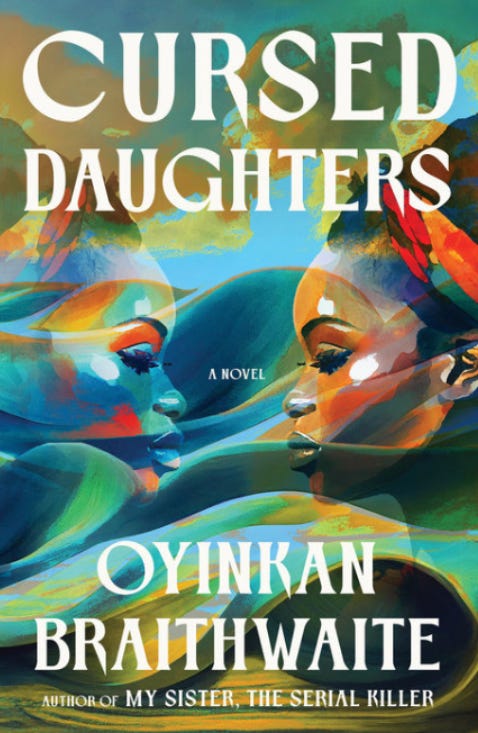
Braithwaite’s second book Cursed Daughters is more speculative than thriller, but it borrows heavily from Braithwaite’s deft ability to detail the secrets and the bonds within a family of women. The novel’s three main characters—Ebun, Eniiyi, and Monife—have a complicated familial association: Ebun gives birth to her daughter, Eniiyi, the same day that the Falodun family buries Ebun’s cousin Monife. Family members soon note that Eniiyi looks a lot like Monife, so much so that the family begins to believe that Eniiyi is Monife’s reincarnation and is fated for a similar life and death. The family is also plagued by a curse that leaves generations of Falodun women heartbroken and abandoned by their boyfriends and husbands, although the manner of abandonment varies. What is consistent is that the Falodun women find themselves living in Lagos, bound together by heartbreak and betrayal.
Braithwaite braids together the stories of the three protagonists across time and the landscape of Nigerian culture as they attempt to navigate the family curse; it soon becomes apparent that their belief in that curse also may in fact not only impact their decision making, but it might also hasten the terrible results they believe the curse is responsible for. The resulting narrative is an unsettling examination of the effects of intergenerational trauma, the weight of family tradition, and the intermingling of the mundane, the supernatural, and the uncanny.
Cursed Daughters is an engrossing read, one that asks important questions about how much of our life and our history is inherited and how much of it we are responsible for—and capable of—creating for ourselves. I’m looking forward to discussing it with you throughout the month of December. We will be in conversation with Oyinkan on December 20 at 10 a.m. PT/1 p.m. ET. You can register here. And if you haven’t already purchased the book, you can subscribe to the book club and receive the selections monthly via Allstora.
If you’ve started Cursed Daughters, what are your first impressions?


I just read it this weekend. A snowstorm halted all my plans and I had the luxury of a whole afternoon of reading.
Adding this to my list immediately!