

In the opening of Douglas Stuart’s 2020 debut Shuggie Bain, it’s 1992, and Shuggie, the 15 -year-old protagonist (who is pretending to be 16) is working at a supermarket in Glasgow, living alone, and hoping one day to be a hairdresser. Before the novel moves back to reflect on Shuggie’s childhood and to illustrate why he’s found himself in this situation, Stuart chronicles Shuggie’s daily deli routine and also his attempts to fill in for a coworker at her rotisserie stand:
“He prayed for strength. Why did no one want a whole chicken anymore? He would lift the carcass using long prongs, careful not to touch the birds with his gloved hands, and then he would dissect the parts neatly (skin intact) using catering scissors. He felt like a fool standing there against the broiler lights. His scalp was sweating under the hairnet and his hands were not quite strong enough to artfully snap the back of the chicken with the dull blades. He hunched slightly, the better to throw his back muscles behind the pressure in his wrists, and all the time he kept smiling.”
Stuart is meticulous in proffering details about Shuggie’s discomforts, the minutiae required to manage the deli, and in his descriptions both of Shuggie’s mother Agnes’s struggle with alcoholism and Shuggie’s attempts to save her. Stuart is also meticulous in his revelation of Shuggie’s queerness and in chronicling Shuggie’s attempt to hide that fact both from himself and from others.
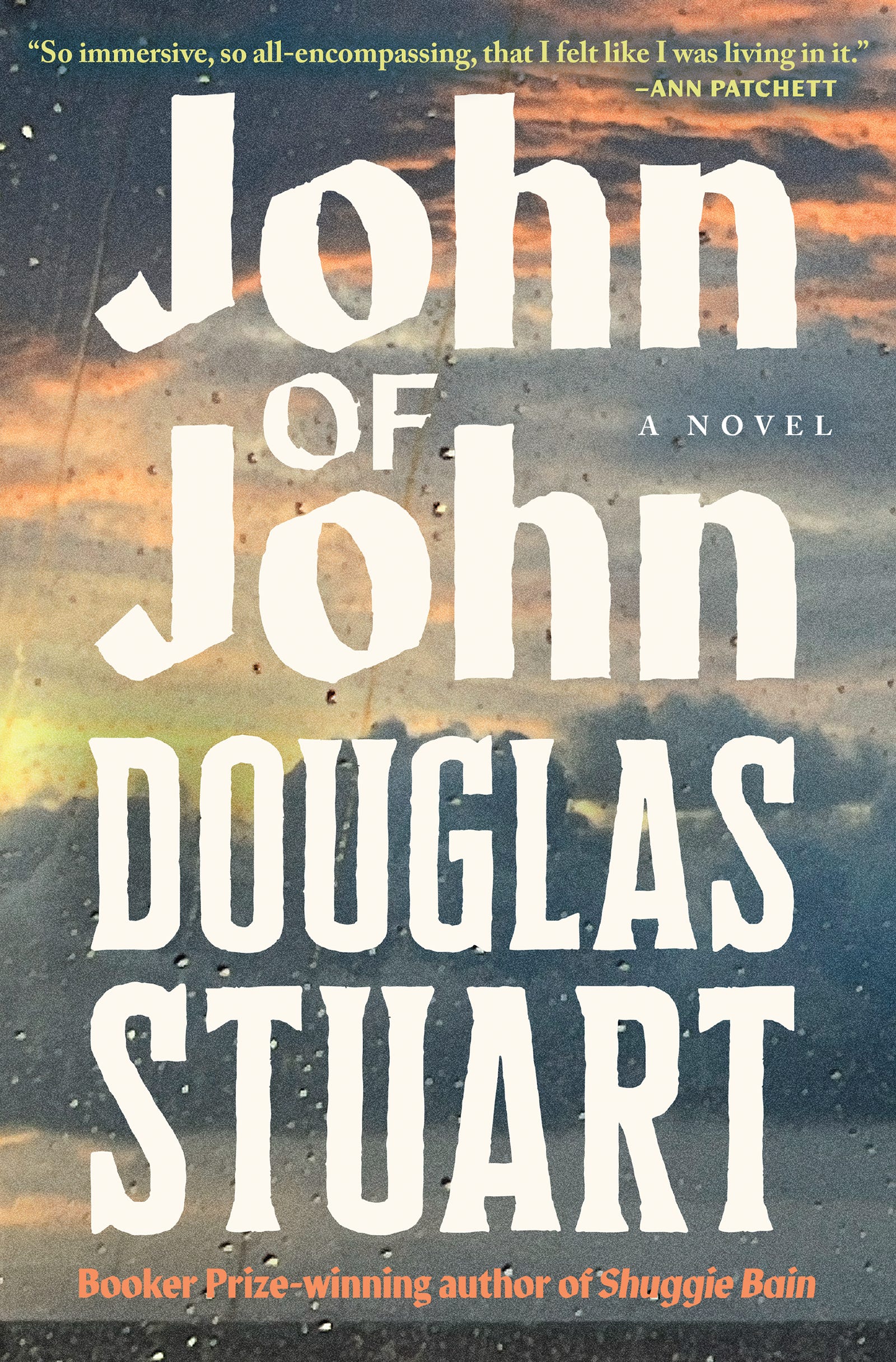
It is that meticulousness and secrecy that also echo in Stuart’s third book, John of John. The novel’s protagonist, John-Calum MacLeod is living in Edinburgh, going to art school to study textiles, when his father calls him and insists he return to his home on the insular Isle of Harris, part of the Hebrides, to care for his aging grandmother. What Cal finds on his return is the same home he left behind and seemingly the same father, a man who criticizes his clothing and hair as well as his decisions. But what Cal soon finds is that nothing is what it appears to be: his father, a weaver and farmer, is breaking one of the key rules of the trade on the island, and his family is struggling to keep its secrets.
In some ways, Stuart’s novel is a faithful retelling of the prodigal son; his language is steeped in both the religious fervor of the conservative Presbyterian church and stark yet bucolic descriptions of the island’s landscape. But nestled within that narrative is a very different story, the threads of which interweave the story of the son with the story of the father, a story filled with sharp and startling insights into the nature of queer longing and loneliness. John of John forces us to consider not the scandal of queerness in communities that pride themselves on adherence to tradition but more importantly the cost: what compromises must people must make in order to love in secret? What lies must they tell? What shape must love take if that love is forbidden?
John of John is a gorgeous and often heart wrenching novel, one that reminds us that we don’t always know our families as well as we think we do, and that sometimes coming home doesn’t ground us but unsettles us instead. I’m looking forward to discussing this wonderful book with you throughout the month of June. We will be in conversation with Douglas Stuart on June 24th at 8 pm EST/5 pm PST. Registration is open!
Have you started John of John? What are your early impressions? If you’ve read Stuart’s previous two novels, what do you see in how his work has evolved?