

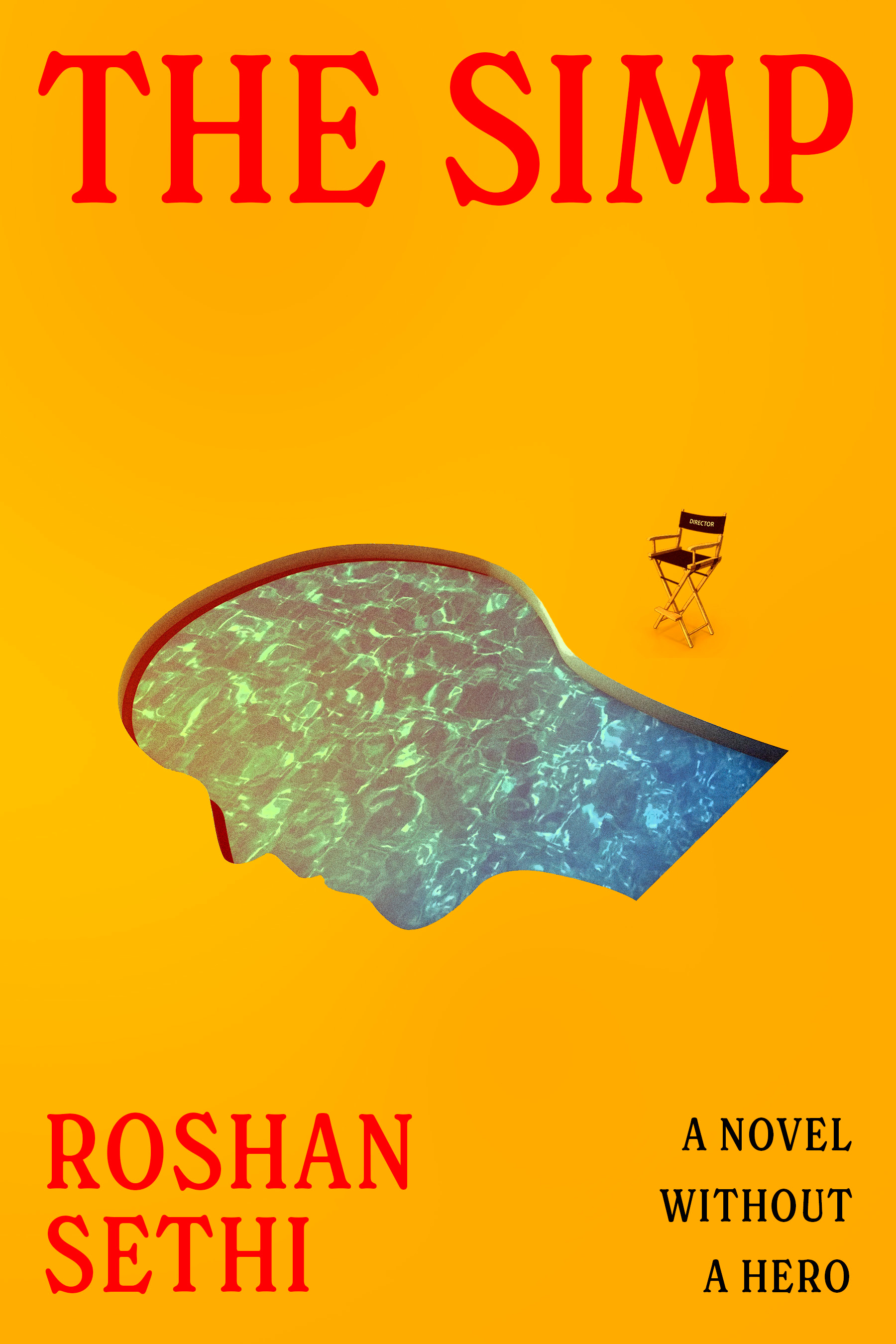
In a recent piece for Lithub, Roshan Sethi writes about picking up William Makepeace Thackeray’s Vanity Fair in the summer of 2024, when he was already upset by how Hollywood was treating him. Sethi, a film director and writer, felt slighted by the post-2020 racial reckoning backlash, and he was looking for somewhere to direct his frustration. (Relatable!) Thackeray’s 19th century classic turned out to be just the vehicle, in great part, says Sethi, because of the book’s cover, which featured an illustration of British elites tumbling down a staircase. Those elites reminded Sethi of the elites in Hollywood, and the comparison inspired him to start writing his debut novel using Thackeray’s as a guide:
The day after I started reading Vanity Fair, I started writing The Simp. I had no outline or plot in mind. I was simply adapting this 200 year old book. I wrote the modern Becky Sharp as Raj, an Indian actor, an impoverished inveterate hustler trying to navigate an elite Hollywood society. He is also, in the vernacular of young people, a Simp.
The Simp is more than an adaptation of Vanity Fair, more than a satire that skewers Hollywood’s film and entertainment industry with Thackeray’s language and lens. It’s also a mirror of the servitude required of medical students, which Sethi also was once; in fact, Sethi is still a practicing oncologist, although he now divides his time between his medical career and his career in Hollywood.
Sethi has long written about medicine, queerness, and how Indian culture aligns with and diverges from the west; his filmography includes long-running Fox show The Resident and films such as 7 Days and A Nice Indian Boy. But The Simp, Sethi’s first book, is a slightly different animal. While it does reflect Sethi’s persistent modern interests, it is also a story rooted in a long literary history of reinvention.
Just as Thackeray’s novel borrows from Pilgrim’s Progress, so too does The Simp borrow from Vanity Fair, not just from narrative structure or voice, but in his crafting of the novel’s protagonist himself. Raj, an aspiring actor who is perpetually looking for his big break, is neither Thackeray’s Becky Sharp or his Amelia Sedley, but instead an amalgamation of the two. As Raj steps into a job for a prominent Hollywood family that he is wholly unqualified for, we see him not for who he wants to be, but for who he is: an unrelenting, mortifying, and yet strangely endearing figure who dons personalities and performances as deftly as he does clothes.
While some of Raj’s actions toward his employers are self-sabotaging and even destructive, Raj is not blessed with a playboy’s cleverness or a psychopath’s capacity for deceit. Raj’s machinations stem more from grief—over the loss of his parents, his inheritance, his dignity, and his dreams—than they do from some drive for self-preservation. This grief is one of the characteristics that allows Sethi’s work to move from adaptation to reinvention. In his hands, satire is not just social criticism of the film industry and the Hollywood elite but also a clear-eyed elegy for the many marginalized people treated as fodder for that system and who fight fiercely to survive.
The Simp is a darkly funny, deeply probing novel, a book that mocks us for looking for a hero even as it understands why we might still desperately be yearning for one. I’m looking forward to discussing this unique, prescient novel with you throughout the month of August. We will be in conversation with author Roshan Sethi on August 26th at 8 pm/5 pm. Registration is open.
Have you started the Simp? What are your early impressions, particularly given that last month’s book, Pool House, was also, in part, about Hollywood.
I started The Simp recently, then set it down after Pool House came from my library hold list. I can see parallels already and I am looking forward to what others have to say. I haven't read Vanity Fair (that I can remember), so this summary was helpful to read.