
The Audacious Conversation with Savala Nolan

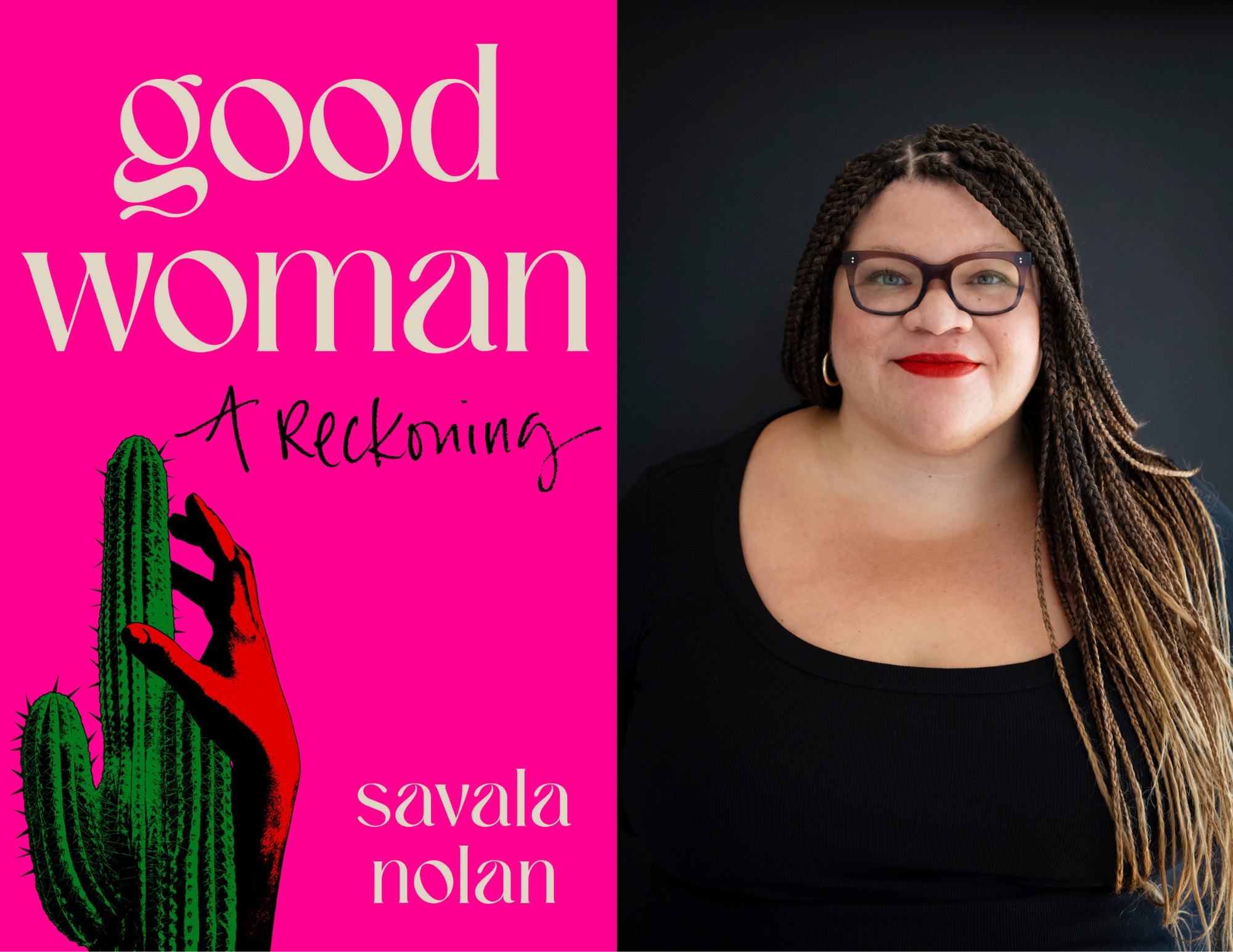
SAVALA NOLAN is an essayist and professor who writes about race, bodies, and gender. She helped create the Peabody Award–winning podcast The Promise, and directs the social justice program at UC Berkeley, School of Law, where she teaches about the role of identity in lawyering. Her work has been featured in Vogue, Harper’s magazine, The New York Times Book Review, NPR, Time, Forbes, LitHub, and more. We recently had a conversation, via e-mail, about her new book, Good Woman: A Reckoning, the right to dignity, and much more.
You work as a professor at UC Berkeley Law, and much of your work focuses on social justice. Can you talk a bit about how your writing, so much of which is deeply personal, prescient, and political, informs your academic/legal work and vice versa?
You’d think they would be at odds, right? Lawyers are usually writing for court, where the writing should be crisp, free from passion, devoid of emotion—just the facts, ma’am. And there is value in learning how to avoid over-embelishment and sentimentality, just as there’s value in learning how to analyze the heck out of an issue, which is something you learn in law school. But I actually feel quite at home thinking of my personal writing as legal, even though my writing tends to be lyrical and come from an impassioned place. This is because it has a home in Critical Race Theory, i.e., the theory positing that race and law have a relationship and this relationship is worth studying. One of CRT’s tools is counter-narrative, which encourages people whose experience is normally left out of legal reasoning and therefore legal protection (women, Black people, queer people, etc.) to tell their stories, and to insist that their stories have meaning that law and policy should acknowledge. So, on the one hand, my writing would be out of place in a courtroom. On the other hand, the practice of counter-narrative, which I come to through CRT, means I see my writing as perfectly in sync with my work at Berkeley Law.
You said in an interview several years ago that you hope that when people read your book that they have an encounter with the truth. Can you talk about what truth means for you, both as a legal term and as a personal one? Given how much untruth is shaping our current political climate, how do we bring truth to the surface?
Legal truth is an interesting concept. In the law, truth refers not only to what actually happened, but what you can prove. If you can’t prove it, then, legally, it isn’t true. In court, you have to put forward convincing evidence before you get the imprimatur of “truth.” But in life, there are all kinds of things that are true but which can’t be proven. You can’t unequivocally prove you love your mom. You can’t unequivocally prove being called a slur hurts your feelings. You can’t unequivocally prove that you’re scared when you cross a parking lot and see a shadowy figure approach you. There is a vast realm of human experience that is true but hard or impossible to demonstrate beyond a doubt to the satisfaction of other people. And in a world where people in power seem to have less and less good faith curiosity about the experiences of others, and where there is open and growing hostility to anyone who isn’t a white man or aligned with the perceived interests of white men, that is a problem. I will never convince the Stephen Millers of the world that being forced to complete a pregnancy I don’t want is a devastating trespass on my humanity. I will never be able to show him that “to his satisfaction.” Thank God for art; art is a place where we can see truth that isn’t yet “proven.” As for the political climate, I find the erosion of truth as a value as confounding and distressing as anyone else. But I think there is a way—it’s a narrow pass but it’s there—for us to move forward even if the concept of truth becomes more diluted. On a certain level, maturity is realizing that I don’t have to like you or what you want to do with your life in order to respect your right to do it (if it doesn’t infringe on someone else’s fundamental human rights). Like, it doesn’t matter if I personally like trans people or “believe” them (I do)--they have a right to driver’s licenses and bathrooms and medical care! Putting this another way: it doesn’t matter if I personally think what someone is saying about their experience is true—they have a right to dignity.
Your first book got its title from a phrase a woman told you at the hairdresser. I am always interested in origin stories so I’d love to hear about how this new book came to be.
The fundamental question of Good Woman—should women strive to be “good,” or should we strive to be something else?—was knocking around in my head for several months before I ever wrote anything. My marriage was ending, a lifetime of dieting was beginning to implode, motherhood had drastically altered my sense of self (obliterated it, really), and I was beginning to suspect that I’d been sold a bill of goods by my culture. My culture told me to be good, meaning agreeable, helpful, relationship-oriented, male-centric, selfless, helpful, and thin, and in exchange for that goodness I’d get to experience fulfillment as a human being. Well, the bargain wasn’t working out as advertised. I’d done all the things I was asked to, and I felt hollowed-out, exhausted, and trapped. As I chewed on these thoughts, I happened to hear a song by the all-female British band The Staves where they sing, “Who will build statues of me when I leave you all behind? I’m a good woman.” It’s a mournful song. What I heard in that lyric and melody was a woman who was fed up and breaking free…but also wondering who, if anyone, would honor all the wasted sacrifice she’d made at the altar of goodness. The song inspired the title.
Similarly, I’d also love to know what you learned from writing your first that was helpful while writing your second. Were there any lessons about either the craft of writing or the research process that were particularly beneficial?
Big ones, for sure. Most importantly, I learned that writing a collection of essays is like building a wheel. The individual essays are the spokes, and the core theory is the hub. All the spokes have to touch the wheel, but they all have to stand alone, too. All the essays have to be nailed to the core theory, but each one has to work on its own as a complete thought, a complete exploration. That’s the difference between a bunch of writing and a collection. And just like building a functional wheel, building a collection takes time. You have to tinker with it, adjust the measurements right, remake certain spokes, expand or contract the hub, and so on. I had a much better sense of how to do this with my second book, and enjoyed the process much more because I knew that, at the end, I’d have in my hands this glorious feat of engineering that could to carry my ideas down any road.
In the first essay of Good Woman: A Reckoning, you write “There is no one word for what you must endure and perform as a good woman, except womanhood.” I keep thinking about the resonance of this definition and about your midlife revelations. Can you talk a little bit about how you came to your understanding of womanhood at midlife?
What I came to realize in my early forties was that, culturally speaking, “womanhood” and “good womanhood” are totally conflated. There is really no space between “womanhood” and “good womanhood.” Womanhood itself is conceived of as being good, and taking all the shit that comes our way—harrassment, humiliation, the stripping of legal rights, the silencing—with a smile. Phrased differently, the only way to be infallibly legible as a woman in this culture is to be a good woman—agreeable, deferential, helpful, etc. A bad woman—and take your pick of ways a woman might be bad—is almost a non-woman. She gets a different name: she’s a bitch, a nag, a shrew, a dyke, or cunt. She isn’t marriage material. She isn’t “hot.” She is no longer a woman. She’s something else. And that infuriated me. It infuriated me that, up till then, I had never found a way to experience my gender unmediated by patriarchy and misogyny.
You wrote about motherhood in your first book, and you also return to it in your second essay in this new book. In the first book, you talk about the trauma of motherhood and the impact it has on the body, but here you talk about some of the fundamental ways in which motherhood has changed your mindset, the way it is an imperative, and how it differs from fatherhood. What have you learned about motherhood since that first book? What are the questions you still have? What has it helped you understand about divinity and autonomy?
I have learned that the “postpartum period” is a fallacy in so far as we mean a few months or even a few years. I gave birth; I will always be postpartum. I will always be adjusting to motherhood, or not adjusting but having to get on with it anyways. The other day I was brushing my teeth and my child called out Mom? for maybe the fiftieth time that day. She wanted to tell me something. It didn’t matter to her that I was in the bathroom, with the door closed, washing myself up for bed—meaning, engaged in my own experience. And that’s annoying! It’s annoying to be interrupted constantly. But it’s just how it is with kids. So, with my mouth full of foam, I said, “What honey?” And internally I had this realization. I thought to myself, Oh—I am never going to get over the irritation of being constantly interrupted. Like, that is not something I’m going to adjust to, ever. It’s been a decade and I still find it incredibly grating. And who wouldn’t? Autonomy shrinks a lot when you have a child. The self-sacrifice and self-abnegation are massive.
That said, motherhood has been the greatest blessing of my life and there are many ways being a mom has been enlightening. For instance, becoming a mother helped me see that motherhood is actually the only set of human behaviors that come close to what any God worth worshiping would embody, and I write about this in the book. This realization that the qualities I was taught to trust in God—constant caretaking, constant presence, infallible love as a verb—these aren’t really the qualities fathers embody as a cohort; they’re motherly. Once I really got that God (or a higher power, Spirit, the Universe, etc.) is actually best understood as a mom, or as a constant unfolding of mothering, I was able to experience my relationship with God on a much more profound level.
In the essay Wyoming, you write about many things, but one of them is about being seen as a Black woman. Can you talk a little bit more about that and what it requires both of you and of the person who sees you?
The essay starts with me and my white fiancé (I’m Black) in a restaurant in rural Wyoming. In the adjacent booth sat some white men, they seemed like they’d just gotten off work, and one of them was telling the others a story that included a racial slur; he clearly looked at me when he said it. He was absolutely telegraphing his disdain for Black people to me. But my fiancé didn’t hear it, and when I told him what I’d just heard, his response was to silently usher us out of the restaurant. He didn’t confront the men or say anything to me. You could debate whether this was the “right” way to handle the moment. And maybe it was. But it left me feeling hypervisible and invisible at once. I felt hypervisible as a Black woman, because these racist assholes just zeroed in on me like I was under a spotlight. Yet I also felt invisible as a woman, meaning, as someone who might need or benefit from a man protecting me from other men. You could argue that my fiancé did protect me from other men by silently, calmly getting us out of the restaurant. But it felt insufficient; what I wanted was for him to confront the men, to check them for me. In the essay I interrogate my desire for a more “manly” response, and like you said, it covers a lot of ground. But what sticks with me through all the places Wyoming goes is how Black women are hypervisible and also invisible at the same time. It’s like the cultural eyeball cannot just focus on us normally. It’s got to either home in on us zealously, or refuse to witness us. In this way, and I write about this, racism and pornography have a lot in common. They both fixate hungrily on what they see in someone while refusing to see that person’s full humanity.
A moment I continue to come back to is in your fourth essay, when you ask your best friend of 25 years whether she’s been sexually assaulted and she says she doesn’t know. As you note, there’s a whole dissertation in that answer. Can you talk about the tension in that question and in the answer? What does it say about society and about the law? What does it say about that definition of womanhood that you present early in the book?
There is truly a whole dissertation in that answer! For one thing, I can’t think of a single other form of bodily trespass—being hit by a car, being shot—where the victim/survivor would have to think about whether it happened. But sexual assault in our culture is not only under-reported, its underrecognized. In my research I learned about what experts call “unacknowledged sexual assault”, meaning unacknowledged by the survivors. I was sexually assaulted by a guy I was friendly with in college, and it took me about 18 years to call it that. This is part of how being a woman in this culture simply requires that you be good—malleable, agreeable, protective of others feelings, dedicated to keeping relationships intact, content under current power structures, etc. If you step outside of being good in this way—if, say, you come forward with stories of sexual assault—you risk being deemed something other than a woman. You risk being a bitch, a liar, a golddigger, a ho. You become less acceptable as a woman if you decide not to be so “good.”
Sexual assault is also, from a conceptual standpoint, under-articulated. If you scratch below the surface, we really don’t know how to talk, and perhaps even think, about this stuff. Language itself presents some challenges: what distinguishes rape from coercion, and coercion from badgering, and badgering from nudging, and nudging from asking? Let’s say someone in a long-term relationship pleads with their partner to have sex one night and that partner begrudgingly agrees. What is that? Is it just part of the typical flow of sexual appetites and relationship-maintanance-through-sex that so many LTRs involve? What about a man who presses a date and makes a couple moves on her that she meets with hesitant acquiescence? Was he just giving it a go, or was he doing something more sinister, even criminal?
Part of the problem, in my view, is that when we try to answer these questions we are focused on what the perpetrator did, not what the victim experienced. But the only way to really know if something was experienced coercively, or involuntarily, or against someone’s will is to focus on the person to whom the thing was done. I think we tend to focus on what the perpetrator did because most perpetrators are men, and as a culture we center men.
Similarly, what are your thoughts on how we think about this question in relation to the revelations about the Epstein files? What does sexual assault mean when the powerful are engaging in these activities without repercussion or accountability, and what does consent?
What undergirds all male-on-female sexual assault, harass, and trespass is patriarchy. Gender hierarchy is impossible to remove from this equation. There is a reason that nearly 99% of sexual assault perpetrators are male, and approximately 91% of victims are female. That’s not random. That’s not a coincidence. Whether we are talking about a random high school student or the world’s most powerful financiers and politicians, there is no sexual assault at the level our culture produces it unless the culture also produces the belief that women are inferior to men, that women are for use, that women and girls are mechanisms—not equal human beings, but mechanisms—through which men and boys get to exercise and enforce power, entitlement and dominion.
Here’s something I learned researching Good Woman: multiple studies show that when you ask the same men Have you ever raped someone? and also Have you ever coerced someone into having sex with you? the same men will answer no to the former and yes to the latter. Isn’t that fascinating, and alarming? Another striking statistic: a study at the University of North Dakota found that while 13.6% of men said they would rape a woman if there no consequences, an eye-watering 31% said they would “force a woman to have sexual intercourse.” These men are more offended by the word rape than by the actions of rape. With the Epstein files, I think we’re dealing with men who are on the wrong side of these statistics. But they were not alone. Their beliefs are, to some of us, abhorrent, but by no means unheard of. Not when gender hierarchy is as fixed and embodied as it is in this society.
You talk in that same essay about Jane Ward’s “the misogyny paradox.” Can you talk a little bit more about what that means and about what it tells us about the nature of heterosexual relationships and the push for equitable marriage?
Thank you for mentioning Jane Ward! She is one of my favorite scholars on gender and sexuality. The idea of the “misogyny paradox” is that straight men are in a knotty position—they are, one the one hand, attracted to women and drawn to them as partners, and on the other hand taught relentlessly that women are inferior to them, almost a subspecies if you take a dive in the Manosphere, for instance. That thorny condition is not exactly a set-up for thriving, egalitarian partnerships. And I think many women who have been romantically involved with straight men identify with this. Their men love them, and want to be with them—but they also want them to modify their bodies in all kinds of ways (shaving, bras, etc.), they want them to do the lion’s share of the domestic labor, they want them to have sex like a porn star, they don’t want to take their woman’s name if they get married because “that’s weird.” It’s like, can cis-het love exist without gender inequality in a starring role? I know a few marriages that seem sincerely egalitarian—where the man took the woman’s name, where he does a lot of the housework, where he consumes media and art that de-center men…and do you know what? In each case, the couples are asked, not infrequently, if the man is gay. It’s as if showing up with equality is antithetical to heterosexuality for men.
In “The Recent Unpleasantness,” you write about how when a police officer sees a Black body, he sees the present moment and a long ago place. I’m fascinated by the idea of racial or state violence, as well as family ancestry, as a kind of atemporality or time travel - can you talk about this concept a bit more?
I read this question and immediately thought, Kindred! Octavia Butler’s book about a Black woman who wormholes from the 1970s to the chattel slavery era is an exploration of this, isn’t it. I suspect most Black people understand that they live in a multiplicity of times. It’s kind of an extra sense for us. I agree that state and racial violence are timeless, in the sense of being atemporal and time-travelesque. That kind of violence is a wormhole. If your people came to this country trapped in a hurricane of state and racial violence, then you could be millennia from that origin story, with a different, modern legal and social status, and state violence would still vault you back in time. It would still collapse the past and the present in an instant, right on your flesh. I think that’s actually part of the power of state violence and racial violence. I think part of its purpose is absolutely to return certain bodies to a former level of unfreedom. That’s the draw of it. That’s why certain groups have a real appetite for it. It’s not a coincidence that they tend to be the same groups who believe Black people, for instance, are inferior.
While I was reading your book, I kept thinking about the work of Kate Manne and the inextricable link between anti-Blackness and fatness and in particular the work of Sabrina Strings, which you both quote. Can you talk about this connection and about how it relates to your argument about Black women’s consistent cultural positioning as object rather than subject?
The first thing to realize is that anti-fatness and anti-Blackness are unnatural, intentionally cultivated, and related forms of bigotry. Sabrina Strings walks readers through how, during chattel slavery, purveyors of mainstream culture worked diligently to create an association between Blackness and fatness, framing both as abhorrent and inferior. For example, in 1836, the extremely popular women’s magazine, Godey’s Lady’s Book, urged white women to control the amount of food they ate, warning that “excessive” eating created an African-seeming body that was improper for a white woman. In 1897, Harper’s Bazaar declared that “to be fat is to be miserable” for a white woman wanting social success, instructing that a fat white woman could only be desirable if she “burnt-cork herself”—in other words, if she adopted blackface.
My contention is that a culture that fears women’s appetite for food is going to fear women’s appetite for everything: power, expression, rights, you name it. And vice versa—a society that wants its women thin and hungry probably does not also want them, say, running the country. Food, ambition, authority—appetite is appetite.
Like everything else, this hits Black women with particular force. Our bodies are often used in service of other people’s appetites, even while we are chastised for expressing our own. Literally: our bodies were put into service to build this country’s enslaved labor force for almost 250 years even as we were told these same bodies were substandard. We are still overcoming this legacy of objectification, and the notion that we are simultaneously too much and not enough. That we have managed to create so much agency under these conditions is extraordinary. But just because we create it doesn’t mean mainstream culture respects it. Take, for example, Nicki Minaj’s Anaconda cover, which shows her butt cheeks in a thong. The media and twitterverse outcry was so paternalistic, with people telling her she’d gone too far and didn’t know what was good for her. She pointed out that nobody seems to say this about Sports Illustrated swimsuit covers. And the difference in reactions is entirely about Blackness and body size. It’s about who we deem capable of wisdom and therefore worthy of making their own choices. I’m not a Minaj fan—her recent foray into MAGA politics is enough to turn my stomach. But she was justified in pointing out the hypocrisy that questioned her right to create art simply because she is Black and female.
Something I admired in your essay “Lest We Die of Hunger” was your point about divorced or spurned mothers and the necessity of selfishness. There’s so much forcing mothers away from this, but you suggest that in many ways, it’s a necessity, especially when it comes to processing pain. I’d love to hear you talk more about this.
Motherhood is, in some ways, the apex of “good woman” pressure. If women are asked to be helpful, self-sacrificing, malleable, relationship-oriented, and quiet before they have children, the pressure explodes exponentially postpartum, and it doesn’t let up. Mothers are expected to self-abnegate constantly, and to put their child’s wellbeing above all else; and there are some very good reasons for this! But there are also some externalities. Should a mother stay in an abusive or miserable marriage “for the child”? Some people say yes. Should a mother complete a pregnancy she doesn’t want “for the child”? Many people say yes, including a majority of the Supreme Court. What connects these things is the idea that it is wrong for a mom to be selfish. That if she puts herself first, she is failing. I experienced a version of this when I divorced; it felt so self-centered for me, as a mom, to write about my marriage, and the hellishness of it, because my child might someday read what I’d written and might not like it. I wrestled with this for a very, very long time. I really tangled with what my duty to her was, and where the line was that separated me as a fully separate, sovereign human being from me as a mom. Ultimately, I chose the selfishness of self-expression. I decided to write about the end of my marriage. I did it thoughtfully, and with my child’s well-being in mind. But I did it. I said what I needed to say. And the gamble here is that, in the end, it’s far better for me to model using my voice than for me to model silencing myself when I wanted to speak. I think a period of womanly selfishness is critical at the individual level and at the level of culture. Women are people from whom so much has been taken, and more is poised to be taken, I believe. An inversion of this norm would do us all good.
In “Boom,” you talk quite a bit about something we hear very little about these days: women’s loneliness. We act as if the male loneliness epidemic is a unique problem, but your essay suggests otherwise. Can you tell us a bit more about your experience with loneliness, how it differs from the loneliness of men, and why women’s loneliness is rarely discussed but men’s has become a cultural emergency?
I don’t dispute that men are lonely. And I deeply wish they weren’t. But to act like it’s a shock, or it’s exclusive to men, feels off. Many men don’t have strong relational skills (which I attribute to nurture, not to nature). If you don’t have strong relational skills, and if your sense of manhood is dependent on being some version of strong and silent, of course you’re going to be lonely.
In hetero relationships, that lack of relational skills is part of what contributes to women’s loneliness. But I think we take women’s loneliness for granted, or we decline to look at the role men play in it. Yes, womanhood has a general element of loneliness. It’s lonely because we are encouraged to see our personal struggles as just that—personal, not political or communal. It’s lonely because women tend to hold shame, and shame can be a silencer. It’s lonely because we are encouraged to think of others—their preferences, their wellbeing, their feelings—more than ourselves.
But womanhood is also lonely because like 90% of women are straight, which means 90% of women are partnering with people who are not highly skilled at partnership. The word highly is doing important work here. Many men are capable of partnership and have a basic grasp on its fundamental principles. But being capable is not the same as being highly skilled. I’m capable of shooting a free throw; that doesn’t mean I’m anywhere close to being Paige Bueckers or Steph Curry. And this is what I experienced in my marriage and see in so many straight couplings. The man isn’t terrible at being in a relationship—but he’s not very good at it either. He hasn’t developed the “higher” skills that so many women have—intimacy, reciprocity, anticipatory caretaking, self-inquiry, an orientation toward growth. And it’s no surprise! Men are not encouraged to develop these qualities because, in our society, they are largely considered inconsistent with manhood. But where does that leave men? And where does that leave women?
One place it leaves them is totally screwed. There is so much pressure on straight women to land a man and keep him, and to make a relationship work even if it means effectively re-parenting your male partner, that even the slightest glimpse of male skill in this arena can be enough to make a woman stay despite how malnourished and overworked she is. This was my experience. I tried for five terribly lonely, starving years to get my husband to check back into our relationship before I realized it wasn’t going to happen. (This is common. 75 percent of divorces are initiated by women who have been thinking about it for five to seven years.)
And men, for their part, are malnourished, too. Even when the women in their lives pour into them, sometimes there are so many holes in the bucket—due to how men are socialized—that no one can fill it no matter how hard they love.
I was reading “Enfant Terrible” and thinking about your conclusions about beauty through the lens of what we know about Epstein now. How do we rethink beauty further now that we have more evidence that powerful men shaped our beauty standards in some very disturbing ways?
I appreciate beauty. I love a cascade of liquid marble on a sculpture. I love a red lip. But I’m skeptical of beauty, too. I think it’s a scam. I think there’s more power in ugliness, or anti-beauty, than we realize. Imagine a world in which women refused to be beautiful. A world where women took stock of the ways they were expected to achieve, perform, and maintain the beauty standards of their culture, and refused to comply. Empires would fall. I mean literally—the beauty industry is worth $450 billion dollars globally. To put that in perspective, if you made $100 a day, it would take you 12.3 million years to get to $450. That figure doesn’t include clothing, or weight control and body shaping, or plastic surgery. And what else would change? What would women do with the money and time and mental energy and physical labor they’d no longer have to perform for beauty? Men would have to rethink everything they think they know about women, about value, about status. Our media ecosystem would explode. How would politics change? Imagine the “MAGA look” replaced with an aesthetic devoid of hair extensions, fillers, lip gloss, etc. I am not throwing shade; remember, I love a red lip! But I really don’t think it’s a stretch to say that, if women eschewed “beauty” en masse and directed their devotions to cultivating ugliness, our culture would fall apart. What would emerge from the ashes?
I also love your point about the vitality and value of the margins. What does life at the margins mean to you, both in comparison to belle hooks’ understanding and in contrast with it?
I think bell hooks got it right. I have no notes. Her basic contention that the margins are the most open site in a society, and a place that can be chosen, is spot on for me. Earlier in my life, when I was still oriented toward normative acceptance, I scoffed at this take. But I am no longer governed by my desire to be acceptable to this culture. I would rather live in the margins of this society than anywhere else. Consider what the center requires: conformity to ludicrous standards of beauty and behavior. Do I really want to be a good woman given what this culture says a good woman does? Do I really want to be thin if being thin requires me to starve myself, exercise compulsively, and flush my mental health down the toilet? Do I really want to be in a marriage—the ultimate normative achievement—if it requires me to drink the poison of my own self-abandonment every day? No.
I don’t mean to imply that the margins are pure bliss. They aren’t. hooks acknowledged this, too. Being marginal means you are, by definition, excluded from some of the goodies “the center” offers. But if the cost of getting to the center is more than you want to pay, or can pay, it should be a relief to know that communal life on the outskirts of a sick society can be quite salutary.
You also talk at length about how the world is made for men and about what it will look like as it disintegrates. What does a new world look like? Do you have any ideas?
I don’t mean just mean it philosophically—the world is literally designed for men. You see it in everything from the height at which we hang paintings in museums to CPR dummies without breasts. I honestly worry that I am so socialized and so acclimated to the myth of male normativity that I can’t picture this new world without continuing to embed male-centricity into it. It’s like, can you ever unlearn your first language? I’m fluent in male supremacy. But I can absolutely imagine the muscular, vengeful, full-blooded, lusty joy of destroying the world made for men. I can imagine the heavy-weight bout, and what it feels like to land a devastating female punch right on the jaw of that world. My primary contribution here is in trying to stimulate an appetite for that feeling.
That said, the first place I’d look to approach this question on a practical level is the Combahee River Collective, whose members argued in the 1970s that freeing Black women would free everyone because Black women’s freedom would require the end of all oppression. So another way to approach this question is to ask: what policies, beliefs, resources, and choices would make the most oppressed, disempowered, silenced, and unprotected Black woman free? Imagine them. Maybe she is trans, and unhoused, and has a chronic illness. Maybe she’s a mom, and has a criminal record, and uses a wheelchair. The policies, beliefs, resources, and choices that protect her freedom and wellbeing free us all.
“Witness,” your essay about Monticello and Sally Hemmings, is a clear-eyed and devastating look at her life and at how we understand it. Can you tell us about what some of the most interesting findings were about her life? What really surprised you?
Thank you for asking about Witness! It’s my favorite piece in Good Woman.
For those who don’t know, Sally Hemmings was an enslaved Black girl/woman owned by Thomas Jefferson, and the mother of at least six of his children. The single most fascinating question to me about Sally Hemmings life is why, after going to France with Thomas Jefferson as a tween, she returned with him to Virginia. Slavery was illegal in France, and it was possible for enslaved people to petition French courts for their freedom, and win.
But she didn’t. We have no records regarding why. The lack of records is one of the worst shadows of slavery, to me. The erasure and redaction of entire lives. All we know is that, (1) when Hemmings and Jefferson returned to Virginia, Hemmings was pregnant with Jefferson’s child, and that (2) Hemmings made Jefferson’s agreement to free their future children a condition of her return. I glean from this that Hemmings was a bright, strategic thinker. She had temerity, she had a clear moral and political viewpoint. But what else can we glean? That she loved him? That he loved her? How could that be possible given the stark power asymmetries? As an intellectual practice, I insist that we allow for this possibility of mutual love; to deny the possibility that Sally Hemmings was loved by Jefferson denies her humanity, and I just won’t do that to her. But also out of respect for her humanity, I am forced to recognize that this scenario—a girl, her literal master, sex—includes massive heapings of exploitation and coercion. How could it not? The situation brings to mind the Epstein files; that level of depravity and barbarism could be what we’re talking about when we talk about Hemmings and Jefferson. But we just don’t know. There is so much we cannot know. I view this as a reason to keep thinking about them, and especially her.
By the way, the question of what love can even mean or look like between two people positioned very differently in power hierarchies? Without flattening anything, this is a question that’s worth asking about hetero couplings under patriarchy, too. I know many, many men who are married to women. Very few of them treat their woman as a true equal.
One of the things I noticed about the conclusion of this book is that the last few essays, which are largely about sex and relationships and pregnancy, have a very different form from the earlier essays (although this begins with the Hemmings essay). Why are these essays more fractured? Can you talk about these artistic decisions and why you made them?
I hope it doesn’t sound twee or trite to say that I go where the essay takes me. If a piece is telling me it’s a series of vignettes, I go with it. Obviously, I’m not just along for the ride—you have to be disciplined about the form and respect the form’s directives. But I listen to what the piece is telling me about itself. There’s a passage in the Tao Te Ching that says, “we can mold clay into a pot, but it is the emptiness inside that makes it useful.” I think these vignette-y essays tend to emerge when I’m trying to highlight the emptiness of the pot. I’m sorry to give a somewhat opaque answer but it’s the truest way I can say it! I didn’t intend for these essays to end up at the end of the book when I wrote them, so that aspect wasn’t intentional. But I hope that the “emptiness” of them—the relatively high amount of “space” in the thinking—leaves room for readers to bring themselves to the book and to contemplate, and to make use of what they’ve read in the prior sections.
We’re talking a lot about what is bringing you joy right now? What is sustaining you?
Well, I’d be remiss if I didn’t mention that feedback from readers of Good Woman is bringing me megawatt joy. I’m not the first woman to hit midlife and start seriously questioning how I was socialized. That middle-aged clarity is common. My goal in writing Good Woman is to help women and girls hit that summit of clarity before their lives are half over! So, when a reader tells me something was revelatory, or liberating, I’m thankful. I also find joy in lying in the sun, swimming and taking baths, eating dark chocolate, and growing flowers. I find joy in contemplating that there is nothing I could do to my body that would improve it. I find joy in smoking weed, too. I smoke a couple times a week. In one way it’s pure, frivolous fun. But in another way, it’s very healing and even political for a woman, a mom, and a Black woman to remove herself from productivity and from being governed by mechanized time.
What are you working on now?
I have long been haunted by my great-great-grandmother’s story. Her name was Laura. She was Black and descended from slaves. She lived in Texas in the 1890s and had two young children. And one day, visibly pregnant with what would have been her third child, she was murdered, in her home, by a gang of white vigilantes akin to the Klan. I first heard this story when I was a kid. As an adult, I had the money to work with Lineages, the genealogy team that does Finding Your Roots with Henry Louis Gates, Jr., to learn more about Laura. I don’t yet know what form it will take, or if what I write will ever see daylight, but her story is calling me.
This is a question I love to ask creative people in conversation: what do you like most about your writing and how you do it?
I like that I can make one helluva gorgeous sentence, one that has rhythm and musicality and makes you pull out that highlighter! That sensation—it’s what I imagine it feels like to stick the landing as a gymnast, or to see the ball go in without touching the rim. Sometimes you hit that period key and just know you made music. Not every sentence is like that, nor should every sentence be a technical, artistic feat. That would be exhausting to read and impossible to write. Some sentences are studs in the wall, others are stained glass windows. Both are important. As to how I do it…I suppose it’s some combination of instinct, practice, editing, a good ear, and being both focused and loose as I write. Whatever the recipe, it always feels like magic.
I'm middle aged, have been for some years, and I've seen this in my own life as well as that of quite a few of my friends: "I’m not the first woman to hit midlife and start seriously questioning how I was socialized. That middle-aged clarity is common. My goal in writing Good Woman is to help women and girls hit that summit of clarity before their lives are half over!" Thank you for sharing your own summit of clarity!
Wow. Thank you for this interview. The bell of truth rings with every answer.