
Tomato, Tomato
Emerging Writer Series

Every two weeks or so I am publishing an essay from an emerging writer. This week, we are publishing “Tomato, Tomato” by Helena Chung. Helena is a Korean American poet who was born in Seoul. Helena has an MFA from the University of Virginia and is currently working on a book of poems on the Korean foundation myth, Ungnyeo and the tiger. Helena’s poems have appeared in A Dozen Nothing, Pleiades, Quarterly West, Salt Hill, The Journal, and elsewhere.
In 2021, I moved to Brooklyn with pieces of a poetry manuscript and no immediate plans for gainful employment. At the time, I had been dating A for almost two years. I felt like if there was ever a time to pick up and move my entire life it would be at 25, and if it would be for a man, it would be for this man.
A got a big-time job in New York, as is expected of those who get advanced degrees in business. I had finished my (second) creative writing degree in 2020 and was restless from a year of staying mostly inside, dealing with a slew of health problems, and adjusting to my first real, non-academic, non-restaurant, non-farmer’s market job. It was a hectic and unstable year. Between the hospital visits and COVID, I felt more aware of my body than ever before, and I was ready for a change in scenery. So, in June, A and I packed up our small semi-basement apartment in Charlottesville and moved to the 43rd floor of a building in downtown Brooklyn.
That first summer in New York was unbearably long. Every time I move somewhere new, I’m shocked by how the changes I feel most immediately occur at the molecular level: the mineral content of the water on my hair, the air quality on my chronic eczema, the pressure change in the elevators on my ears.
Despite the slow ebbing of the pandemic that summer, I didn’t go many places. It felt too hot, too unfamiliar, and most importantly: I felt ugly. I was ugly in my body—so fat and sweaty. On the subway, I constantly worried I was spilling out of my seat, invading the personal space of the person next to me. I was ugly in my clothing, which was hip, maybe even fashionable for Charlottesville, but way uncool for Brooklyn. And the most ugly and embarrassing thing about me was that it was clear I didn’t know where I was.
I have always taken pride in my above average ability to literally know where I am on a map. Thrown into this vertical city, I had little sense of which brownstones, which bike rack, which cash for gold sign I had passed before. I was constantly flipping and turning my phone to orient my internal compass when emerging from the underground, careful not to block the stairway by retreating behind a hydrant or tucking myself behind a particularly deep pilaster.
Every excursion tested my patience with myself. If I wanted to try some cool restaurant, it was an introduction to a new subway line, a new neighborhood, a new cross section of streets. If I wanted to get some groceries to fill out our new apartment’s pantry, I had to scour the internet for a place close enough that I wouldn’t overextend myself lugging things back, wander in, and hope they had what I was looking for. Sweaty and out of breath, my hair curling wildly, I would ask the clerk if they had any zaatar, hot pot seasoning, or gochujang.
* * *
In Virginia, I always fought off the dog days of summer with tomato sandwiches. K-pop blasted in my ears as I waded through the already dense air to get to the Water Street Parking Lot where I spent most of my Saturday mornings. I had to walk a lot of the time because 이모 had a setup that took longer than most of the other vendors. If I was scheduled to open, I had to leave my place well before the first bus of the day. On the days I was asked to come for the later shift, I took the nearly entirely empty first bus of the day.
The setup was a stove with two burners, two tents, a table for displaying kimchi, a small eating area, a ticket rail, and a table for expo. If we got it done quickly enough and the bulgogi was cooking in the pan by 6:40 a.m., I could go and do my rounds around the market. My route was the same every week, even the weeks I didn’t work: Susan and Marian at Althea Bread, then Earl, Fran, and Maria at Bowerbird Bakery, then Double H Farm if I remembered to bring cash, then Francisco’s Farm stand, then back to work before seven.
I kept all my groceries and treats under the expo table, covered by the tablecloth, as safe from the heat as possible. Then, for the next five hours, it was like nothing else existed outside of what I could see. The people waiting in line, the full ticket rail, the kimchi jars sweating in their iced display containers. Five hours of calling out names, explaining what kimchi is, asking people if they wanted to add avocado or egg to their breakfast bowl, sneaking bites of my own breakfast in between it all.
After we broke down for the day, sometimes 이모 would let me take home the extra veggies or rice so she didn’t have to take them back to the farm in her truck. I lugged my goodies back to my apartment in the midday heat, stopping by the butcher on the way back to fill out my groceries for the week.
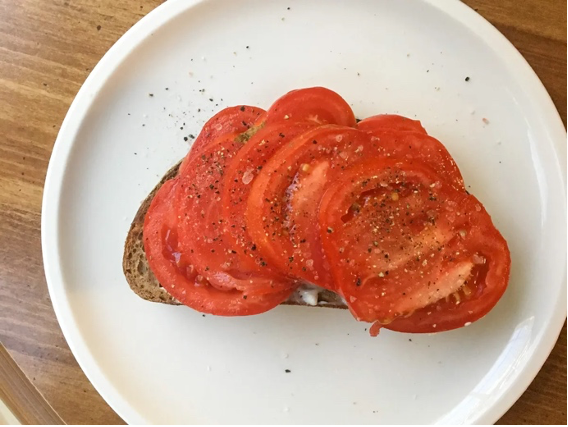
By far, the most joyful of the meals I pieced together from those hauls were tomato sandwiches. A whole tomato thickly cut, sprinkled with salt and a few scrunches of black pepper on Albemarle Baking Company’s Pain de Campagne (or milk bread, if I had the energy to make tangzhong) with a generous helping of Duke’s Mayo. It’s simple and it’s perfect. The juice drips down your chin when you first bite into it; it soaks the bread and drips into your hands and onto your plate as you eat. It’s all the toils of a season of growing, from the last frost to that moment you bite into it. All that heat, those rainy days, that patience—it turns into a sweetness anchored by acidity, it cools you down and reminds you...“I have wasted my life.”
* * *
My first Saturday in Brooklyn, I schlepped over to the nearest farmer’s market—late June, the beginning of ‘mater season. Charlottesville business-branded tote bags in tow, I bought kale, eggs, strawberries, crusty bread, and of course, two pounds of tomatoes.
Those first two pounds ended up going towards a pasta sauce because to get Duke’s in Brooklyn, you have to order it off their website and get it delivered. It has to be Duke’s because the apple cider vinegar complements the acidity of the tomatoes and brings out their natural sweetness and the texture is unmistakably fluffier compared to other brands. A small roadblock. It took a couple weeks to ship, but that just left me square in the middle of the season, with plenty of tomatoes left to be bought and eaten.
When the package arrived, I ripped open the box and began making my sandwich shortly after. I cut the tomato into thick slabs, sprinkled the Maldon salt and fresh black pepper while it was still on the cutting board, slathered the Duke’s on bread I had toasted in a frying pan, and assembled. She was gorgeous, she was that girl, she was beautiful.
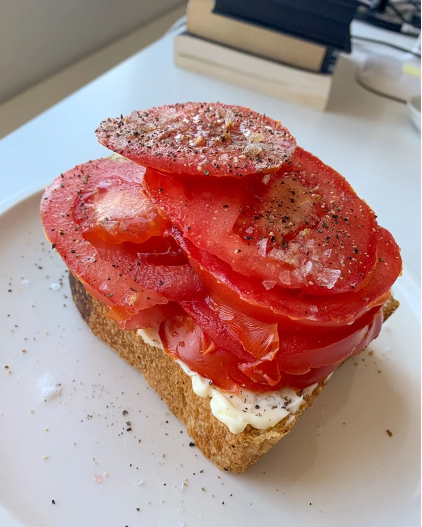
But even as she was all those things, she was disappointing. Though the tomatoes were just as big and juicy and perhaps even more photogenic, they simply were not the same. They felt blander, not as sweet and not as tart. Traces of those water-logged slices I picked off my burger as a kid lingered somewhere in the fruit. I suspected because of the soil, because they were greenhouse tomatoes, maybe, or because of the climate.
I should have known better than to have such high expectations. I have always said, “there’s nothing like a tomato sandwich in the summer in Virginia.” And with such cloying pride—as it made me feel like I was from somewhere, it made me feel I had known a place deeply, down to its roots. But for the first time in that high-rise, with the first bite of my sandwich still stinging my face and hands—I felt the truth of the statement.
For someone in a relatively fragile mental state, this was a devastating realization.
* * *
With nowhere to go, with A chained to his desk for his big-boy job, with no tomato sandwich in the peak of tomato season, I worked on my book. I wrote a few new poems: a sestina about drinking, a long poem about my first real relationship, a short poem about A and me. But the bulk of my work, as is typically the bulk of all good writing, was editing. I revisited poems that I had dropped into a folder titled “junk,” which was a folder within a folder within a folder within a folder. I stashed them in there after hearing some famous writer say that if she felt stuck on a poem, she shoved it into a drawer where it wouldn’t see the light of day until she was ready to work on it again. I guess I was hoping the poems would ferment—like 이모’s kimchi—I wanted to believe that I had the right recipe and the poems just needed time. But of course, the poems were ugly too.
I scanned poems obsessively, I put them in Sapphic stanzas or dactylic hexameter, only to abandon the form a week or two later. I worked on that book like it was my 9-5 job and entrenched myself in my own ugliness while suffocating in the hot radiating off all that metal and concrete.
That summer in Brooklyn, I was cruel. To myself, to my poems, to my friends, to A. I felt betrayed by the promises of beauty. Betrayed by the tomatoes, betrayed by the picturesque view of the city from my apartment window, betrayed by A and my friends, who all had jobs and little to no time to hang out with me. Even as the weather cooled, I rotted. I complained. I was angry. I was scared. I cried.
* * *
My favorite John Keats poem ends with the lines: “Beauty is truth, truth beauty,—that is all/Ye know on earth, and all ye need to know.” When we read this poem for a class, my friend Caleb said, “I think all my friends are beautiful, but I know that objectively that is probably not true.” Statements like this are part of why I find Caleb’s poems to be so beautiful.
Once, that same year we were reading Keats, Earl at the Bowerbird Bakery stand at the farmer’s market asked if I’d prefer a cinnamon roll from the corner, edge, or middle. When I said I didn’t care, he gave me a look and said, “Of all people, I expected you to care.” I considered this briefly then replied, “I just think they all deserve a good home.”
From then on, I intentionally bought cracked macarons (there weren’t many if any; they were all true masters of their craft at Bowerbird) because I knew they’d get a little cracked during my walk back home anyway. When I went up to Francisco’s tent, I’d always take the ugliest things. The most cat-faced tomatoes, the scarred zucchini, the sadder-looking cilantro starts. Partly because of trust—in my whole time purchasing their wares, I never had a bad product. Partly because I knew if I didn’t take them, there was a high chance they’d be left at the end of the morning. Packed back into crates and moved to the next market they had, up north in DC on Sundays or east in Richmond during the week. And then?
* * *
It took time to adjust to New York. It took making new friends, re-connecting with old friends, getting an okay job with a mission I thought was worthwhile, taking a poetry class, going to bookstores, ice cream shops, movies. Slowly, I found the beauty (and truth) in all the ugliness. I ate bagels. I had my first New York slice. I became a regular at a Chinese takeout.
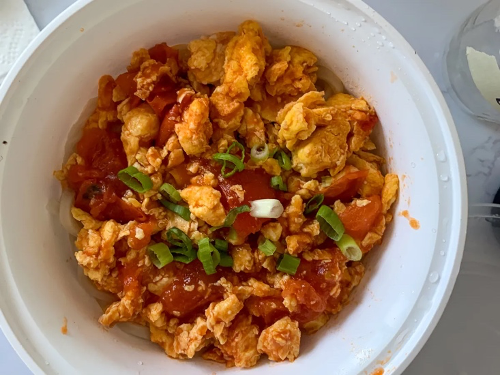
Xifu food is a pretty classic NYC Chinese takeout. A single counter and a few tables in the front. There is always a grandma in the back, sitting on a stool and making dumplings. Upon my first visit, I ordered tomato egg noodles for the first time. I had always been curious but had never had an opportunity to try them myself because, well, tomatoes for me were a precious commodity, always used for sandwiches or made into a freezable sauce for the dreary winter months.
The noodles were carb-y, thick, and springy, like udon. They absorbed the umami and sweet notes of the tomatoes, which were cooked down to a pillowy softness. The tomato skins added a nice textural element to the chew. The eggs were abundant, which was ideal because they are essential to every bite—the scramble forms delightful pockets for the juices, sugar, and chili oil.
I shouldn’t have been looking for a Virginia tomato sandwich in Brooklyn—I don’t go to Charlottesville looking for bagels. I was entitled, thinking I was owed beauty, some magical experience. I cringe looking back at myself. Especially because I’ve since learned that one of the things that makes New York (and by extension New Yorkers) so beautiful is its ability to persevere, to find a way, to create something beautiful and true in spite of, or oftentimes out of, something that seems ugly.
That first bite of tomato egg noodles held me, comforted me, and reminded me that tomatoes, in any form, are a kindness, a beautiful and true kindness.
 | A guest post by
|
Loved it! Glad I'm growing Early Girls at home ☺️.