
Unfinished Canyons
Emerging Writer Series

Every two weeks or so I am publishing an essay from an emerging writer. This week, we are publishing “Unfinished Canyons” by Chelsey Reid. Chelsey is a Kentucky-based writer whose work explores public health, harm reduction, and connection. Her previous work includes, “He Is Survived By His Sister” published by the Bitter Southerner and “It’s Not the Heat, It’s the Housing” in Testament: A Rural Anthology from Backwoods Literary Press. She spends as much time as possible outside with her dogs, one of which is a basset hound mix so terribly behaved that they are perfect.
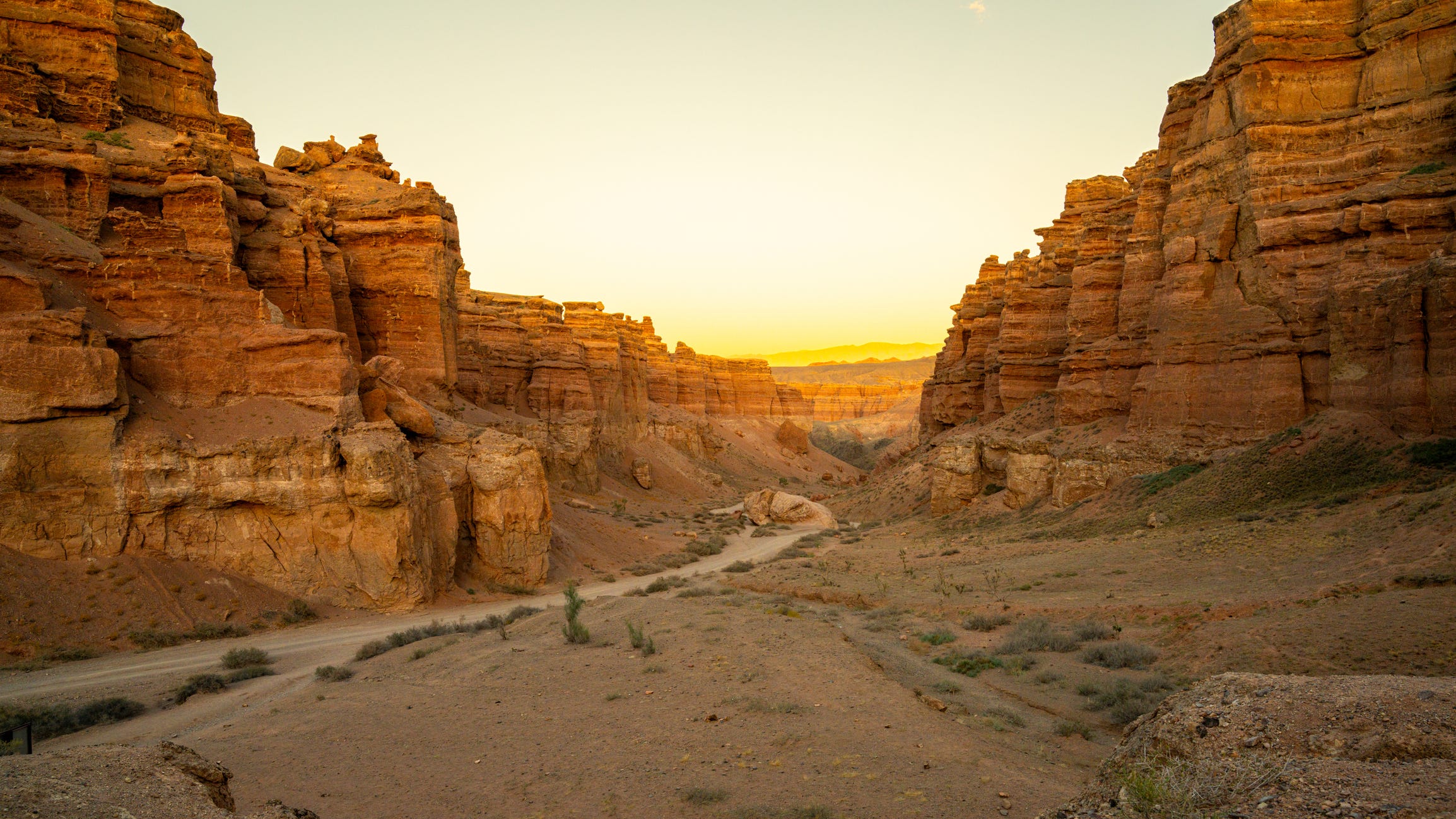
Several miles into our hike, the early afternoon light bounces off the canyon walls, illuminating everything around me. While I’m scrambling over rocks, an opaque ripple in the sand, a tear in time, snags my gaze. Paused study reveals the faint edge of a shadow flagging against the ground. Reaching for the undeniable blip, my fingertips connect with a pottery fragment. She is resting weathered side up, as anyone who’s really been somewhere is apt to.
My friend and her husband had welcomed me on their annual getaway to southeast Utah, my first time in canyon country. Back home, I’m a public health professional navigating yet another unprecedented season, one during which funding and services are falling like orange and yellow leaves, stinking in their decay. Compounding the combustion of my beloved field, my marriage is unraveling faster than I can grasp the fraying seams. The planes of my life were shifting rapidly, the compass guiding my next steps spinning with wanton abandon.
Throughout our journey, Brandon, a long-time desert devotee, generously shared that which can’t be bought in the form of skill building and storytelling. The oceanic vastness of the place stunned me to surprised tears, and I was overcome by unexpected sanctuary among the black widow spiders and the mountain lions, which I felt but did not see.
Brought to stillness by this found pottery fragment, my feet pulsed in my shoes. The bones themselves felt engorged after traveling for miles through rock. My lower back, usually tight, felt loose and strong. Somehow, out here in the endless nowhere, holding this broken thing, the static tide of my anxiety, a condition that sometimes made me feel like I was jutting beyond my own outline, went placid. After two weeks of hiking and bathing with wipes inside a borrowed tent, I was fully within the bounds of myself. Though finding (and leaving) artifacts while adhering to leave no trace principles was enthralling, the most unexpected find was the realization that I felt safer in the desert backcountry than in my day-to-day life.
***
In 2014, I stood in my aunt’s kitchen in Colorado Springs, performing an impassioned soliloquy in defense of my choice to pursue a graduate degree in public health. Yes, art, writing, and books were the essence of what it meant to be human, but if one is not first physically and mentally well, we don’t have a chance at joy, I reasoned. She unapologetically pointed out that such a track may not leave room for my other interests, ones that, from her perspective, were central to what made me myself. My aunt is one of the most influential people in my life, but as a daughter and sister of Kentucky’s opioid epidemic, I was ensorcelled by public health’s promise to help whole communities at a time. Furthermore, public health was a secure, sensible field. With this choice, I would never again be hungry.
But then COVID-19 wrought undeniable truth, whether one believed it a hoax or legitimate health peril. After the shakedown, we were shown that public health is both broken and unvalued. With my newly-minted degree, I set forth only to slowly burn down and question how much good I was doing, how much aid I was really providing. For the sake of immediacy, direct service programs are often able to yield some sort of in-the-moment care. But the aspirational dream of the practice is to stop harm before it happens. With the available hours, resources, and skill primarily dedicated to the bleeding hurt of the latest crisis, were we ever really moving towards that dream land?
***
I returned home from the canyons with sand forever enmeshed in my socks. Later that same summer, I found myself tasked with work travel to a place I knew well: Washington, D.C. Many years had passed since Washington, D.C. was new to me, but I’d never been in the city at the same time as an active National Guard deployment.
I was twenty-one years old the first time I met the all-important city, a place that made my pulse quicken like I was somebody. Limited finances kept me from attending the traditional middle school visit to the nation’s capital, but in the summer of 2009, I earned an undergraduate student internship and stipend. I didn’t have a car and was reliant on public transportation for my entire experience. I walked countless miles, waited for buses, and spent so much time on the metro that one morning I got overheated and passed out. I learned the city well.
During that inaugural visit, I was mesmerized by the National Mall, the frame of the Smithsonian Institution, the largest museum in the world. The collections were impressive in their magnitude, though I’d been taken with the seemingly innumerable visitors from everywhere and the fact that this largess was entirely free. No matter your personhood or budget, if you could make it to the city, you could stand face-to-face with the medals and flotsam of history.
Weighing the chance to attend the conference in Washington, D.C. against what was safe for myself and my team, I was beset by uncertainty. My work had morphed into an intentionally vicious maelstrom of confusion stirred by seemingly politicized policy changes and funding cuts. The shape of our country’s past and present is hewn by white supremacy and the exertion of control by relegating anyone different as deviant, an unavoidable variable in this attendance calculation. Though attending a national-level conference is both exciting and important, I had concerns about leading team members who held a multitude of identities to a centralized meeting point in the grips of unchecked policing.
The project I served was dedicated to HIV intervention and prevention, work forged by an ancestry of wise and willful risk-takers. I was unsure about my place in this lineage. Flooded with anticipatory fear of this previously known place, we had pre-trip meetings to discuss safety plans and travel strategy, predetermining our litmus for cancellation if needed. We connected staff with one another and encouraged traveling in pairs. For previous conferences, I met with staff to coordinate session coverage, always encouraging attendance to at least one new or obtuse session, believing in the necessity and fun of exploration. In advance of our time in D.C., we created a centralized index of everyone’s flights.
Upon arrival in the city this time, I was greeted by National Guard members and eerie announcements in the metro explaining the increased presence of “Special Police.” Making my way to my hotel, dragging my hot pink and blue-patterned rolling suitcase, I couldn’t help but notice the sea of ubiquitous navy and black suits donned by the people around me. The air of business had long been intrinsic to D.C., but now it read more like conformity.
Between conference sessions, I took long walks down many paths I’d traveled many times before. On one such evening walk, the National Mall was bathed in setting sunlight and idyllic temperatures, a blissful early September rarity. The curated gravel paths were noticeably and uncomfortably uncrowded. Ambling toward the U.S. Capitol, I passed an occasional tourist, most of whom were speaking a language other than English. I observed the locals on their evening runs, even a small running club for kids. Those of us who were out were accompanied by armed National Guard members, strolling alongside as if it were perfectly normal.
The National Guard members patrolling the Mall traveled in pairs, not unlike some of the visiting tourists or running locals. I wondered if it was their first time in the nation’s capital, or if they’d previously attended a school field trip or completed an internship. Maybe they even had an old T-shirt or a magnet they’d gifted as a souvenir back home. Were they also filled with fear, or perhaps another emotion?
A family with two small children crossed paths with one patrolling pair, a young girl approximately 6 or 7 years old with a white bow and pink purse running nearest the soldiers. I watched the adults in the family watch the running child with a steadfast gaze, their walking speed precisely matching the soldiers’ pace.
Reaching the pond in front of the Capitol, I stopped for a while, feeling as though I had the vista all to myself, because I nearly did. It was me and the ducks bobbing about the pond. They oscillated between gliding like ice skaters and unexpectedly flipping upside down, rear ends perpendicular with the sky. I watched them for a long while, noticing their persistence .
Six months before my afternoon at the Capitol Reflecting Pool, before National Guard units patrolled Washington, D.C. alongside tourists, I announced to our team back at work that we were modifying the demographics section of one of our forms. Specifically, we were removing “transgender” and “non-binary”, as gender identity options. This erasure seemingly stemmed from an executive order issued by the White House on January 20, 2025, entitled, “Defending Women from Gender Ideology Extremism and Restoring Biological Truth to the Federal Government.” This edict had snaked its way through federal and state agencies, finally reaching our program.
Other programs had made similar changes on account of the same causal heart. How could they? How dare they! In the name of public service, we are supposed to reduce harm, not cause it. What cowards.
The request for compliance arrived for me by way of a non-descript virtual meeting invitation on a Wednesday afternoon. During the meeting, the expected next steps were delivered with the nonchalance of a regular lunch order. “There is no choice but to do this” was the implied message, the subtext being that funding continuance hinged on acquiescence. Immediate implementation was presumed. Hurried hours were spent wheeling through how to make this announcement with my bereft colleagues, even selecting a poem to read that shared sentiments I was no longer sure I could say myself in my present role.
As a member of program leadership, I succinctly explained that we were removing inclusive gender options from our forms.I couldn’t hear my own carefully planned words over the roar of my elevated blood pressure, a state which left me feeling as though I were sinking beneath the meeting room. As a bisexual woman, I knew I was betraying my queer community, enacting policies that discounted people and places that made me feel safe and whole. We used our forms to provide already underserved populations with services to diagnose and treat HIV and HCV, outcomes that impact the LGBTQIA+ community at higher-than-average rates. In that panicked moment my focus was on preserving jobs and services, but in my belly I felt the irrevocable staining of my complicit cowardice bloom.
“I really hated you for a while after that meeting,” a colleague later confided.
This colleague wasn’t sharing something I hadn’t also felt toward myself. It was shocking, really, how ineffective resistance was individually or even as a siloed leadership team. If we’d started with open discussion as a whole program, or maybe if we had reached out to those partnering programs experiencing the same disruptions, I wonder if we may have had a different outcome? We may or may not have been able to stop the wrong wrought by the mandate. We could have fought even harder for our community and ourselves through prioritizing connection over rapid compliance. In retrospect, we may have had a different outcome if we’d started with open discussion as a whole program, or maybe even if we had reached out to those partnering programs who were also experiencing the same disruptions.
In public health, data collection is a tool we use to measure needs within communities, report service effectiveness, and to apply for funding. Part of my grievous heartbreak was from knowing that if we weren’t collecting inclusive data, we may lose the opportunity to provide equitable services.
Data has always felt like a tangible piece of someone’s story, a manifestation of our unique stardust, and is born from an exchange of deep trust. Data collection can be flawed and cause more problems than it solves, and this change felt like a stark deviation from best practice standards, because we were writing specific people out of the story.
Although the significance of the social determinants of health and corresponding disparate health outcomes are known and documented, this structural change was derived from the very system charged with the mission to protect. The weaponization of policy and compliance implores that we ask better questions about the best way to practice public health. What if communities were the stewards of their data and stories, not agencies and programs?
During my D.C. walks at the conference in September of 2025, I saw stickers of resistance stuck to light posts and overheard locals loudly discussing the banality of National Guard occupation over dinner. I visited the National Museum of African American Heritage & Culture, a museum only in concept when I was an intern many years prior. At the conference, colleagues generously shared what was happening in their home communities and stories of how they were navigating the chaos. Elders to the work were unfairly and magnanimously brave, commenting with drum-like steadiness that we had been through hard before and survived. Forms could be unjustly and harmfully edited, but survival could not be erased because here we were.
As the conference unfurled, trepidation transformed into excitement as team members described what they wanted to take home in support of our continued work. On the last night, a group of us went to dinner. Following our meal, some folks made their way back to the hotel and others pressed on for more city sites. As each group went forward, my heart ached listening to our laughter and conversation ricochet between the buildings, nearly visible in the air.
***
I’d seen the woman and her child just a few minutes prior, enjoying the music at the regional 2025 Pride festival. I’d returned enlivened from my canyon vacation, my late summer work travel to D.C. still on the horizon. It was early June, the season when summer humidity wrestles spring into submission, and this rural community was gathered for their second annual Pride festival at a local park.
It took a few seconds for me to comprehend that she was rushing back towards us, her child now embraced with a vice-like grip. She was shouting something about “shooting” and even at this distance, I could see the white part of her eyes encircling her dark irises. Her full tilt, wide-eyed state meant only one thing. Run.
We were at this festival offering free health resources, such as HIV-testing and safer sex supplies. I was there with team members from our agency and a partnering agency. My presence alone was intended to be a safety measure. As a program, we’d moved to staff each Pride event with a member of the leadership team to proactively offer support during this heightened time. Before I left the house that day, my partner said, “Wear good shoes.”
Earlier in the afternoon, I’d heard a discernable popping that seemed to emanate from thick trees bordering the park, almost like the sound of a transformer blowing in the distance. I, admittedly, know nothing about firearms, but it was a marked enough sound against the sunny happenings of the day that I turned to a colleague who lived in the area and asked, “Is there a shooting range nearby?” She casually explained that there was one in the county, but not close.
Now, festival attendees ran towards the heavily treed area near the park for protection. Others ran behind the main event stage, discharged fight or flight crackling in the air with the midday heat and sweat. A staff member had their personal vehicle near our booth, and we scrambled inside, the coaching of, “Things can be replaced, people cannot” ringing in my ears. We drove to the other side of the park, as far away as possible from the direction of concern, and waited. From our place of refuge, we could see what appeared to be local law enforcement moving with rapidity in the parking lot nearest the gunfire. After minutes that felt like hours, the activity in the parking lot slowed. We rolled the car windows down, and a fellow event attendee passing by shared that per local law enforcement there was no active shooter, no threat to the festival, only a neighbor responsibly enjoying their second amendment rights next to the park on an undeniably lovely Sunday afternoon.
“You were so CALM! Thank you!” my colleague cried. Still sitting in the passenger seat of her vehicle, I looked at my hands resting in my lap. I could see them but not feel them. They were shaking uncontrollably.
Though I was grateful to hear this was but a moment of misinterpreted recreation, I began understanding what I’d seen as we sought safety. While the collective festival took to the trees, hid behind the stage and vehicles, the counter protesters who were present at the event walked around with confidence. They were not ducking or running, but fully upright like diagrams depicting the final stage of evolution, signs promising damnation without repentance held high overhead. They traveled from sheltered group to sheltered group, proselytizing their message of salvation, leveling their signs at the intended targets.
***
It was a Friday night in early spring, before my sense of safety and solidarity was rendered with greater honesty, and I was wide awake. My partner mumbled something about being tired and slunk off to sleep. We’d fallen into a pattern of detached, automated living, as is common at times with cohabitation. Rather than trot alongside and slip restlessly into bed, I paused and said I’d be in later, that I was staying up for a bit.
We’d recently moved into our home, a house with an open floor plan and big rooms. I sat on the living room couch for a few minutes, feeling my solitude beneath the tall ceilings. I wondered what to do next, both in the moment and with the amalgamating mismatched pieces of life. Eventually, I hopped up and squirreled away into my office. Roving through my desk, I found a roll of craft paper and stretched a nearly 4ft. long piece along the wall, taping it up with little concern for the cheap paint haphazardly applied by the sellers.
The trip to canyon country loomed. I wasn’t sure yet if I was going on my own or if my partner would join me. With the canyons in mind, I drew cliffs and boulders, the paper large enough to require stretching effort. Time recently living in the deep south had filled me with a new love of alligators, so in this moment of doing exactly what I wanted, I began drawing a large alligator right in the middle of the canyon.
My canyon alligator was dazzling, eyes and lips curled skyward. Standing back to enjoy my work, I snapped a quick picture and texted it to my friend who’d invited me on the forthcoming trip, quipping something about canyon dreams and alligators I’d known. Ever enthusiastic, she responded back that the drawing was lovely, explaining that alligators (perhaps crocodiles) actually were in the canyons at one point, given that millions of years ago the canyons were under the sea.
Nearly a year after traveling to new canyons, the canyon alligator remains unfinished, shining teeth bared and clawing to climb out.
 | A guest post by
|
What a lovely piece, Chelsey! I have been to both Utah canyons and Washington DC in the past year -- DC sort of feels like it belongs in a dystopian movie at times, and yet the pollinator garden still has butterflies. They don't seem overly impressed by fascists or fences. Here's to the butterflies!
Wow Chelsey you knocked this one out of the park. Fantastic. I’m honored and overjoyed to be a part of this story, especially knowing how much the redrock country landscape affected you. We can’t hide out there and introspection is inevitable if we don’t fight it.
Beautiful piece 🙏